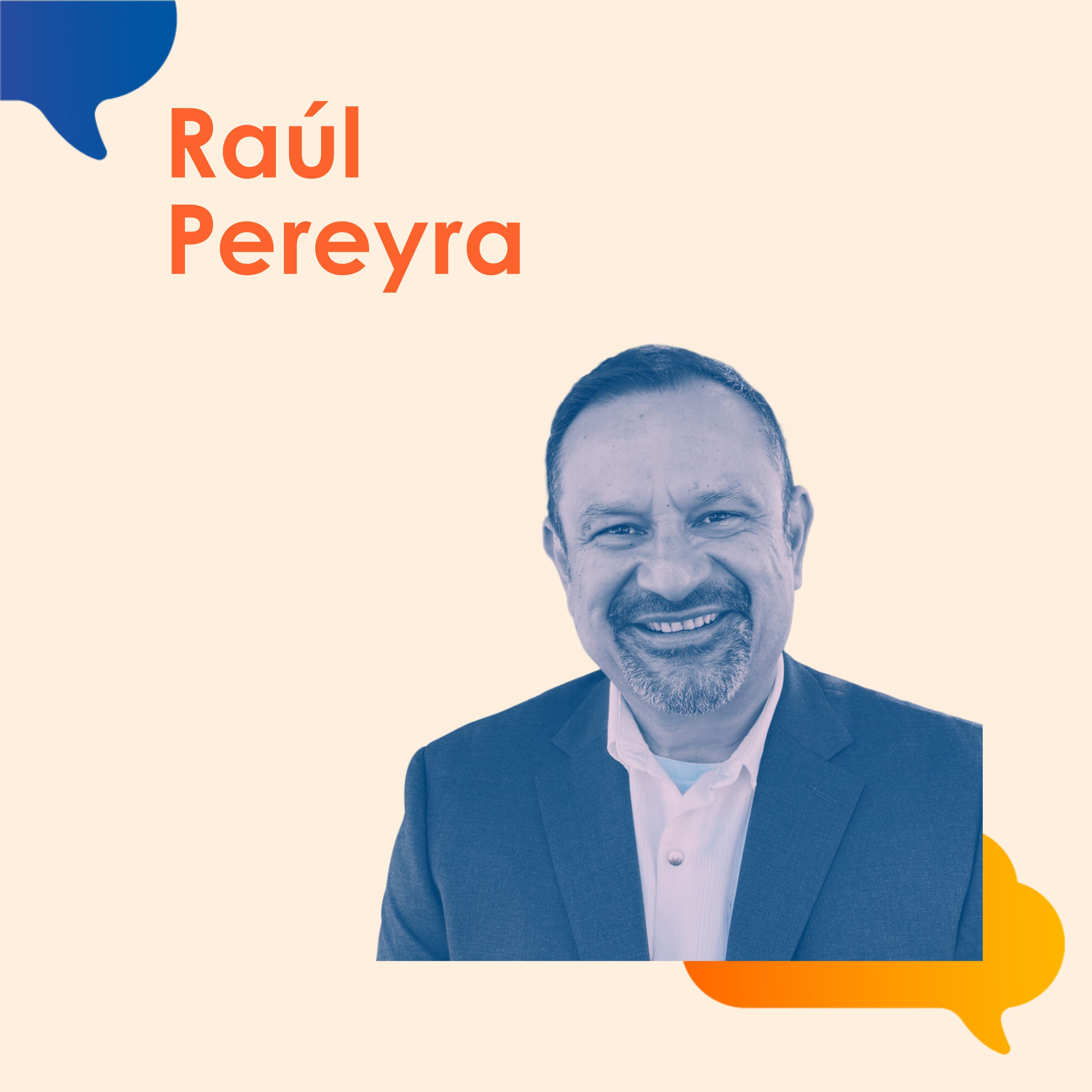
The Bag You Didn’t Know You Were Carrying - Raúl Pereyra
About This Episode
4th and final episode of the mini series - Rewriting the Script of Your Life.
We all carry something—beliefs, assumptions, and patterns that quietly shape how we show up.
In this episode, I mind-blended with Raúl Pereyra, executive coach and founder of RTP Learning, to explore “the bag”—and how it often holds us back without us realizing it.
We talk about self-doubt, the inner critic, and why growth isn’t about quick fixes, but learning to see what’s been there all along.
If you’ve ever felt stuck or not quite ready, this conversation might help you understand why—and what to do next.
Take Raúl’s free 5-day challenge! With only 30 mins a day, see how much you can transform in 5 days through 1:1, private coaching with him.
About Raúl T. Pereyra
Raúl Pereyra is an executive coach and founder of RTP Learning, helping leaders navigate self-doubt and step into bigger roles with confidence.
His work is shaped by his own journey—from growing up in a chaotic, survival-mode environment to confronting the beliefs and patterns that once held him back. After a life-altering health scare, Raúl shifted from chasing quick fixes to doing the deeper work of transformation.
Today, he helps leaders unpack what he calls “the BAG”—their beliefs, assumptions, and protective patterns—so they can lead with clarity, confidence, and intention.
You can connect with Raúl on his website https://www.rtplearning.com/coaching, Linkedin @rtplearning and Instagram @raultpereyra.
What resonated with you today? What topics or guests should we feature next? Let’s keep the conversation going—connect with me on LinkedIn @Mind-Blend, Instagram Mindblendpodcast or mindblendpodcast [@] gmail.com.
Follow Mind Blend to get notified when new episodes are released.
0:00 Me growing up in an alcoholic environment, I am so grateful that experience happened for me. Now that's the shift right there. Many people say, oh, this happened to me. When you say it happens to you, you're a victim. You're a passive. You're just part of that story. So now I'm able to say it. I am so grateful this happened for me because I quit drinking. I show up more presently with my my kids. I'm very committed to my wife and I know the kind of person, a kind of parent, I'm going to be. That's my guest today, Raul Pereira, an executive coach whose work is deeply rooted in his own journey from growing up in chaos to reframing the patterns that wants to find him.
0:48 Now he hopes others do the same. In this conversation we explore the invisible back we all carry and how unpacking it is often the first step to becoming who you're meant to be. This episode is also the 4th and the final one of the miniseries, Rewriting the script of your Life. Welcome to Mind Blend, I'm your host Karen Chong. In each episode I talk with people who've experienced something real and we breakdown what made the difference so you can see yourself and the world. Around you more. Clearly spot what you might have been missing and move through life with a clearer way forward.
1:24 If you like what you're hearing, share with those around you and subscribe to Mind Blend. You'll help a lot in spreading the insights for anyone who can use them. Let's blend. Hi, Raul, welcome to Mind Blend. Hi, thank you for having me. I'm so excited to contribute my insight and just learn more and and have a positive conversation. So I'm happy to be here. Well, I'm very sad to talk to you as well because Raul and I went to the same university. It's not that common nowadays, now that I'm living in London to meet a fellow alumni.
2:00 So I'm very excited and I want to ask you to tell us a little bit more about yourself and how you got into becoming a executive coach. OK, thank you for that great introduction. So I'm Raul T Pereira, originally from Southern California and background is Mexican immigrants, my parents, I'm first generation. A lot of the work that I used to do really centered around learning and development, human resources, teaching. I have a master's degree, so I was able to teach at the Community College level.
2:35 So I found myself always gravitating towards standing up and speaking to people or with people and having those kinds of dialogues where I'm imparting knowledge. That's always been a big interest in my life, you see, because one of the things that I always struggled with, I, I grew up, I'm an adult child of an alcoholic. So I grew up in an alcoholic household and you know, my father was a violent alcoholic. So it was stressful, it was difficult, it was traumatic growing up in that household. So I always, I, I spent as much time away from home partying, being outside, hanging out all day as a teen.
3:21 Obviously I was got gone like Thursday, Friday, Saturday, Sunday gone, gone, gone again party and underage drinking, you know, probably doing some of the things that I shouldn't have been doing at such a young age. I just remember as a young teen and then as a young adult, always this idea. I think the word that comes to mind is escaping or, or this idea of let me just go out and and and teach. Let me go out and engage with others. Let me go out there. I was always the person who would try to step up in a leadership role and always the person who would try to do something.
4:01 You know, coming from that background with an, you know, an alcoholic father, you know, I never knew if I was going to get the loving, caring version or if I was going to get the violent version. In my mind, I'll be honest with you, I always looked at myself and like, I'm just going to do something. I'm just going to get out. And, and now that I think about it, actually the love and the nurturing that I did get at home really came from my mom. But, but here's the the crazy part. I didn't want to be like her, meaning trapped in a, an abusive alcoholic relationship.
4:36 So I actually saw myself as leaving the nest and it's moving on. And This is why I ended up leaving Southern California to, to the Bay Area at UC Berkeley, where we both went to university. So, so that's kind of the origin story, so to speak, a little bit of who I am and, and some of the deep emotional motivations of, of later on as kind of I start discovering my voice as as a coach. Mm hmm. But coaching hasn't been what you've been doing this whole time. I imagine no one no one graduates college and start.
5:10 And like, become a coach, That's true, no? No, no. Tell us a little. Bit more about the journey that led you down this path. OK, so just to pick up along this, this this story, as I shared with you in 2019, we moved from Southern California to the the San Joaquin Valley in California here where this is the city called Fresno, but it's right next door to Fresno. It's called Clovis. And my wife's family is from this area and everything was great, you know, 2019. And we're trying to figure out what we do next, you know, and we decided like, OK, well, I'm going to stay home with the kids and try to go out and do some work, some human resources consulting, remote, which I did.
5:54 It was great. But in 2020 and 2021, I've about four years ago now. Yeah. We were visiting friends in in the Bay Area and Christmas time and I had a severe case of appendicitis. I mean, severe, yes. Meaning I was in the hospital Christmas Day emergency operation, and I can still remember recovering and I was on the 8th floor pretty high and it was raining and I was looking down at my kids who were waving at me. This is during COVID, so they couldn't come inside to visit me. And you know, we're saying Merry Christmas.
6:36 And man, it that really broke my heart. That really just tore me up. Because you were not there with them. I was not, yeah, I was not there with him during Christmas Day. And and that moment after multiple surgeries, multiple hospital visits, we came back to Clovis. You know, I was in and out of the hospital at least three or four times. And I had a PIC line connected to, to my, you know, to feed me for about 3 months at home recovering. So I lost a lot of lot of weight. I was just really not, I was in a dark place emotionally.
7:13 And I think that would help me was I started learning and reading more about psychology and, and because my background is really human resources and adult learning. And I always had this itch to, to, to improve myself. And I always heard a lot of leaders and people talking about, hey, you know, Raul, just give me the shortcut, give me the checklist. Just throw training at the problem, right? And it that never sat really well with me. It was always like, no, there's like you have to internally have to believe and have to be able to change and have to be able to call out, you know, behavior that's not right.
7:57 So I had a lot of thinking during my recovery And at that moment I was already I was doing consulting. I was doing part part time PUT consulting remotely. Human Resources. Yeah, human. Yeah, human resource resources consult Team I I interact with with good people, but some of the owners or some of the executive staff were always the same. You're like, well, we'll just write my my freaking policy and don't tell me about this behavior stuff. What shortcut? Were they looking for? But exactly right.
8:26 So the biggest shortcut was this like, hey, Raul, a lot of my people are quitting or how do I can I just fire this person? They don't do what what they want me to do. And I'm just trying to break it down where it's like, well, it it's really about how you approach it. You know, how you, you know, if if you view this person, your worker as just a number or somebody who is coming in and just doing work, then you're never going to see them holistically. You're never going to see them as the person who they truly are and their true potential.
8:57 And when you're not able to see them in that light, then there's no way you can interact with them in a very genuine and authentic way that that you can actually see and support them in their own growth in their own right. Because when you do that, when you care about your people, guess what, right? You're, they're going to care more about your, your, your mission, more about the business objectives, you know, like treat people like people. So that's, that's really one of those shortcuts were always like, can we just train the problem away?
9:28 Can you help me create a case to to fire this person? Can can you know, and I'm like, it's, it's not that easy, right? And this is how I started forming my ideas now as a coach, where it's like I've been hearing this in my professional life. I've been hearing that same voice or that same theme, you know, quick fixes. It's always about the quick fix. And, and that This is why now I'm like, OK, I decided to pivot and I decided to, to actually quit. I'll be honest with you, I quit my consulting because that was no longer calling me and I was doing more of the same.
10:07 So that that was kind of my wake up call. You know, I went through this illness and I like there's more to life than just pushing paper in human resources. And I just didn't want to do it anymore. I was like, I've been living in fear. I've been living in reactive mode. And I just found myself thinking like Nope, I'm pretty much done. Culture is one of those things that there's no quick fixes or it may go faster if everyone's on board. So I know now you're focused on helping new leaders. So and by new leaders is someone stepping into a bigger role for the first time, whether or not they're ready?
10:50 Because I see this a lot is there's always this saying of well, you will never be ready. So if you wait until you're ready like that would never come. But then when it comes to career, I do think there's a level of readiness as well. So I'm really interested in hearing like how you tackle this, whether it's lack of confidence or lack of experience or just personal self doubt. How does that look like when you're helping your clients? I love it. I love that question because there's a quote, some that somebody said for organizations, it's about culture, right?
11:25 And for individuals, it's about character. So being able to elevate your character and your standards is really the key component to the work that I do. So as, as I made this pivot, I started going deeper into psychology and the, the, the learning aspect of human development and how we change and transform. And I was very, I was influenced by Doctor Benjamin Hardy, who's an organizational psychologist and he has a framework 3 FS, which is frame floor and focus. And I adapted that framework and I've added more to it, and I made it more about the individual because he's talking about organizational development.
12:11 And for me, I looked at it as what I call is understand who you are and you're the way the lens in which you are able to frame or reframe your experiences. If you've had a bad experience, for example, in public speaking or stepping up in a leadership role, yeah, that story will live in your mind. And because it was a bad experience, it's one of those it starts to develop as a protective habit, what I call a guardian. So the inner critic or the one who whispers in your mind like, hey, you're not ready or you're not good enough for this role.
12:53 They are really just trying to protect you because you fell on your butt because you think you're not ready because you've had some mixed bad experience in the past and they're just protecting you. So what I do now is teach people that to acknowledge the inner critic, for example, or the imposter syndrome or the perfectionism or, or hey, I'm not ready, so I'm not taking action. If you're able to start naming on those protective patterns and that's happening inside of you, then you're going to be more equipped with being able to deal with it.
13:27 So once you understand that there's a process that happens in your mind, right? A thought occurs first, right? And then it's backed up by a belief system and then it's supported by some assumptions that may or may not be true. And then it manifests into those behaviors. The protective patterns that I was talking about South for new leaders, for example, one of the biggest issues is am I making the right call or am I making the decision or people going to find out that I'm not confident that I'm not, I'm not supposed to be here.
14:02 And I think to to to the example you gave is do I need to move now or should I be wait until everything's perfect until the everything's lined up? Yeah. So, so being able to unpack that. Mm hmm. In a very methodical way, using what we call positive psychology and my own lived experience, I think that's been now I'm I'm, I'm actually very happy because my lived experience, especially the experience of growing up with an alcoholic and then going through this severe illness has allowed me to adapt and use some of these positive psychology tools and frameworks that I started to develop and actually start healing and actually start moving and transforming from the inside and be able to show up in a more authentic way.
14:56 So if I can do this for myself, I know I can do this for others. And, and I know this, this is true for many, whether you're Latino or many other minority or BIPOC leaders who we're kind of wrestling with our cultural background. You know, we're, we're like, well, shoot, I need to represent, right, the, the Asian community, the Asian community or the Latino or Latino community. Definitely a little bit of. That, yeah, you know, there's some of that. So exactly right. So it becomes, it gets amplified and you're like, well, why do I need to represent, you know, yeah, but, but nonetheless, nonetheless, that's that's where the the work that I the true passion and the true support and the the true success stories that keep me going is when I, when I work with new leaders and helping them understand and get over the imposter syndrome, for example, or the inner critic and, and and it, it, it takes time.
15:53 It's not, it's not a quick fix, but it's, but it's a beautiful journey. And I think This is why I I finally found what I meant to do as my second chapter in my career. Well, that's great. You hear so many stories of kids growing out in abusive or, you know, alcoholism family. They don't turn out that great themselves. So I really like. Congratulations. Yeah. Thank you. Thank you. Coming out doing the right thing for yourself and for the others around you. So you mentioned like success cases. Can you share any like your favorite case study?
16:37 I have a couple. I think one of them is I'll just use his first name, Jonathan, just super awesome, very nice man, just very great. He's a PhD and I think working with him for several weeks that as we talked, he, he was able to, to, to share with me is like Raul, you know, the biggest take away with your help has been you helping me through being able to reframe my past, reframe my experiences that that has helped me, has given me the power to take, to rewrite my stories essentially, right? And I think what resonated with him was this idea of the inner critic that because I'm helping them discover, I can't give him the answers, right?
17:31 There has to be their answers. And he's discovered that that it's OK to acknowledge your inner critic and still move in spite or because of the inner critic and understand that that inner critic is playing any a crucial role in your development. And so it was really nice to see that from another man. And one of my Korean clients, she's female and she's actually the CEO of a nonprofit. And she's one of my favorites now because we got to a point where, you know, the work is hard. So it took it took several weeks to get where we're at, but I think in the last two or three weeks we're now speaking the same language and we're like, I'm super exactly.
18:21 We're root. I'm rooting for her because her confidence level has transformed, right? It's it came from, you know what, not as high level confidence. But now she's able to say, wow, I'm able to reframe or look at my daily wins on a day-to-day basis and I'm building momentum and it feels so beautiful and so light. Now I'm showing up more confident. I'm showing up as a more present leader with her executive staff members. So just seeing her transform from where she was to where she's at now and her telling me how grateful she is.
19:03 And the beautiful part, it's she's one of my favorite because she's now her fiance is doing some of these tools and practices that we're working together. So I see the love and support in her relationship. And for me, that's like, wow. Like I can see a permanent shift and a new lifestyle in terms of self-care and self growth because she has a partner who is supporting her. And to me, that was just beautiful. So was it like your work help her reframe things, not just in work, not just in the work setting, but in general.
19:46 So that kind of bleeds into. Her. Exactly. That's exactly it, right? You have to be able to transform the inside first. You right, the inner transformation has to happen first before you're able to express and make change externally, right? Because this is where confidence comes from. You have to be able to say I am. Confident in my own skin and in my ability to lead effectively. So therefore I am taking the next step with confidence. And then you're going to show up more present in here. And that, that is so true.
20:20 So when we started working together, she wanted help with trying to articulate like how she's going to scale the next level in the nonprofit and, and in, in discovery and talking with her, there was some other issues holding her back. And I think once we were able to look at the internal issues and deal with those stories that, that were holding her back, then she was able to move forward. And just really quickly, I think what's important to highlight here is that as, as we're working together with, with her with or with, with anybody, you know, part of my framework is that we get stuck in the past.
20:58 We get stuck in many stories that we tell ourselves and, and if we don't unpack, you know, this bag that we're carrying and you start refashion it, then you're always going to be how it's going to keep you stuck. For example, she and and and my other clients. Once you start to understand that that you are in control of how you reframe your past or your experiences and how you identify. Once you really have that light bulb moment of like, wait a second, I am the captain of my ship. I am responsible for my results.
21:35 I am responsible for the meaning I'm giving these experiences. What what, what happens by default and I'm guilty of it. I was guilty of it a lot is that we tend to operate in a very default way. One day leads to the next day, and what what we end up when we do that, we're laying our past. Negative experiences, for example, drive our current. And what I'm doing now is we have to flip it around where you and the president are giving meaning to the past and not allowing that past to drive you, but rather reframing the past, giving a new meaning to the past.
22:17 And I'll give a brief example. So for me, now, I can say this with conviction and happiness, right? Me growing up in an alcoholic environment, I am so grateful that experience happened for me. Now that's the shift right there. Many people say, oh, this happened to me. When you say it happens to you, you're a passive, you know, you're, you're a victim, you're a passive. You're just part of that story. So now I'm able to say it. I am so grateful this happened for me because I quit drinking. I, I show up more presently with my, my kids.
22:54 I'm very committed to my wife and I know the kind of person and kind of parent I am going to be. So I am extracting lessons from from that traumatic experience. And it's not easy. It's really, it's not easy. It's a it's a daily practice. But I can tell you this, if I never made that mental shift, just one word, right, it happened for me instead of to me, I probably still would have been stuck and angry and, and you know, still blaming, you know, the alcoholism. And that's not healthy emotionally.
23:28 So I'm, I'm very grateful that I'm, I'm able to reframe that experience that's happening for me. So when I help others reframe their experiences, you know, everybody's unique and everybody will have their own stuckness or their own experience or past that is holding them back. Yeah. And being able to unpack that gives me a lot of joy. So I want to go back to your experience a little bit. Sure. I wanna hear about the bag that you've carried. I love it to carry. You're gonna make me cry. No, no, I'm kidding.
24:04 It's. Very only as much as you. No, no, I am totally kidding. But but so I want to explain briefly so you know the bag, right BAG, it is the beliefs that we hold and the a is the assumptions that hold those beliefs to be true. And then G is guardians, right? Are the protective patterns like the inner critic, perfectionism and what not, right. So for me, I, I carried a bag in many different ways. I think the most significant bag, the heaviest bag I carried, my first bag, so to speak, was as a young adult because the bag I was carrying for the longest time was survival mode.
24:51 Because I yeah, exactly. I did grow up in a chaotic home and I was missing in action. I was partying Thursday through Sunday and I was always looking for opportunities to just be with others, build relationships. Have I had a lot of friends? Right. I thought the more friends I surrounded myself with, the more loved or supported I felt, right? But looking back, that first bag was really about survival. So I had to unpack that, you know, recently, you know, I'm a grown man now with two kids and I carried that bag for 40 odd years and just being, you know, so you can imagine how stuck I was or how my confidence level in on as a parent or even somebody who drank heavily and bitched used to binge drink alcohol because that was, you know, when you're carrying that bag, survival mode, like that's your identity and then that's how you operate.
25:54 So you're you're living in survival mode reactive and you're always looking and scanning the environment because there's a threat, right. So for me, that has been the biggest transformation in my life where I was able to unpack and test those beliefs. What were the beliefs and assumptions and guardian? Sure, one of the beliefs was really about if I allow myself to be loved or to or if I if I allow somebody or if I love that love doesn't last. Love never lasts. So you can imagine what we're going to have a different episode about love and then my crazy Rd.
26:39 there. But but none the less, this idea of like love never lasts. It was a belief system like, you know, right. And then the assumption was if you get close to somebody, they're going to hurt you. So, so I assumed right, you know, right. And then the Guardian was the actual manifestation of that, that, you know, unfortunately, I, I viewed women as more of, as objects than partnership, you know, and I'm sorry to say that that that was my operation during that time. The way I operated, it was like, Nope, I'm just going to get whatever I want out of them, but no meaningful relationship because I'm not going to let them into my heart because I know that it doesn't last.
27:28 And if I do let them in, they're going to tear it up. It will hurt you. They're going to hurt me and and again, this is I know that I'm not the only one. I know that there's countless men and women, right, that we, we carry around that kind of bag. And, and the way I named that bag was survival mode. You know, it's like I acted, I believed, assumed and acted out of survival mode because that's what I grew up in. So now the beautiful part of where I'm at today in the last four to five years is that I transformed that bag, right?
28:02 So, and I was able to name and to say, you know what, as a child, as a young adult, that bag served me well. It was protecting me, right? I was. I learned at an early age as a child how to survive. So your transformation happened in 2019. Yes, yes. Oh wow, so that turning point was a lot more recent than I thought. Well, you have to think about it right? I nobody will ever admit, right that that we carry these issues with us and these baggage, or we carry these assumptions and belief systems that are limiting us.
28:42 Yeah, they don't see it. Exactly, we don't see it as a bag. And I I just like to, I keep it simple and like to again, through the psychology work that I've done and through my own experience, I'm able to like, wow, this is a bag. And then it's like, OK, you know, this is the beliefs, assumptions and guardians that that come up. Like, I'm very honest with myself, right? I always was on this trajectory of engaging with people and trying to be a good person, right? I always knew deep down I was a good person.
29:11 I always knew deep down I was moving in that direction. So the illness that I went through accelerated my transformation, I guess is or, or was the catalyst, if you will, because. Yeah, now that I think about like I was, I was like, not that I was broken all of my life, but I was a regular human just like you, right. We're talking to just like you, a regular human struggling with my own baggage. And in 2020-2021, as I started, you know, once I made that shift in my mind that it happened for me growing up as an alcoholic, a true, I'm talking about a true transformation happened, you know, and some people, you know, it, it's religious, right?
30:05 You know, it's like, you know, born again Christian, for example, it's like a true transformation, right? So I'm very happy that I, again, I was on this trajectory. I know I was, I, I, there was goodness in my heart. I know I was moving along. But if I, if I'm honest with you, it was just day in, day out, clock in, clock out, marry and find a Good Wife, which I did find a great person, good kids, and, you know, just lots of default behaviors. And now because of this transformation, it's with intent and with a very, very, very, very clear purpose.
30:42 And for that I'm grateful. And again, This is why this idea of, you know, having gratitude and being grateful for why this experience happened for me is so powerful. And This is why now that bag has been transformed into a jetpack, because those old stories that I used to tell myself are now being reshaped and reframed into rocket fuel into, into behaviors, into new belief systems and, and new behaviors for me to act upon and accelerate and, and become a more present father, for example. And I think the example I shared is like the very clear example, the number one thing that came out of this like Nope, I'm going to quit drinking.
31:23 Gave it all up, no alcohol in my life 0. Yeah, it's never easy because you've seen former Alcoholics or the relapse. It's just they just keep repeating themselves. So very, very glad to hear that. Thank you. If what we have said resonated with anyone, anyone who's in similar situations, because it doesn't even have to be them becoming a the president, the CEO, they can just be promoted. They have their bag, they believe they're not ready, they're not good enough, the assumption and they have their protect guardian mechanism.
32:00 What is the first step that they should? Say, OK, great. Well, I actually have a gift for the listeners. Oh, listen, yeah, it's a free, it's a free gift. It's a five day challenge. And I everybody loves challenges, right? It's a tiny challenge. It's a five day challenge. It's 30 minutes a day and it's it's the challenge to see how much you can transform within five days. So it's RTP learning.com back slash tiny to the word tiny like small TINY. So it's RTP learning.com back slash tiny, TINY. And there is a, an application simple and if you are ready to start or or are ready and wanting to show up more confidence in any aspect of your life, especially if you're stepping up into a new role.
32:53 And it again, it could be a promotion in at work. It could be the head of a department or a group or whatever it is. And where there's self doubt and you want to become more effective or Start learning and you're up for a, you know, tough love and you're up for me challenging you and your belief systems. I do have that. It's a five day challenge where you can take it and I make it free because it gives us an opportunity to go be one-on-one. And, and many people, you know, they're people this may resonate with a lot, but you may not be ready to do it.
33:37 There's probably going to be that one person out of the hundreds and hundreds of listeners that they're going to say, Oh my goodness, this is the opportunity that I've been waiting for and I'm going to take him upon it. And This is why I make it free because I know there's going to be one person who this really hits home and they're ready because there's there's many of us. We're just not ready. But if you are that one person and you want to take me up on this tiny challenge, I would love to be your coach.
34:06 It's free opportunity. 5 days. Great. Well, thank you for the gifts, first of all. And a lot of the time it's you really just need that, you know? And now let's play rapid fire. Oh, OK, Carrie, I'm ready. OK, what was the best leadership advice you've ever received? Done is better than perfect. Yes, I've heard that, and I I agree. All right. Worse leadership advice. Just go ahead and fire them. Yeah, which I have and I oh, and I regret doing that. Just very transactional, you know, tit for tat. Yeah.
34:55 What was a book that changed how you think about leadership? The Gap in the Game by Dan Sullivan and Doctor Benjamin Hardy. This is all about internal. It's not necessarily a leadership book, but it's really about measuring your progress forward versus measuring yourself against some sort of ideal into the future. And you keep moving the goal posts. So just looking at hey, I'm running my own race and this is how I'm able to show up more more presently and more fulfilled and more happy. Do you have a morning routine?
35:29 Or you just wing it. No, no, I have a morning routine. So, so going back to the gap in the game, one of the things that my wife and I have been doing for the past four years to support the transformation, right, is that we record our three wins for the day in the evening in a journal. And then we write down the three wins or the three games we want to have for the next day. So each night we review how well we did those three wins for the day. And if we missed any of those, it's our job to reframe, to look at an experience we had during the day and transform that into a lesson.
36:07 Because that's the power of moving in this transformation where you can have a crappy day, but if you're, but if you learned something because of that crappy situation, that's the game. So we do three games to share. We share with each other. She shares her gains and, and what not three games in the evening and then three games that we want for the next day. And it's just a cycle. And what ends up happening is we're just on this winning streak. We're just always winning, always gaining. And we're just moving, moving, moving closer and closer to our purpose.
36:38 Well that's so nice. So your wife is also a part of the transformation. Yeah, yeah, yeah, we exactly. So now it's our family, right. And so that's our routine is, is that and I'm up in the morning roughly around 5:00 in the morning, journal a little bit, try to do my work in the morning and then my kids are up and we got to get breakfast and the day starts up. And then most of the morning is for this kind of work as I'm making kitchen with you or with my clients, and then the afternoons and the evenings is for my family.
37:09 Nice. It's very not chaotic, Yeah. Yeah. Which is good. Yes. What do you think is the hardest part of your job? The hardest part of my job The hardest part of my job? Two parts 1 in my mind, I live in two worlds. 1 is RTP learning, the CEO of RTP learning, always reminding myself when I get into a gap mind frame or thinking like, oh, I should be further along in my business and I start comparing myself to others. You know that's a gap or a bag issue, right? So the beautiful thing is I have language for it.
37:47 So once I hear it, then I'm able to pull myself back in and say, wait a second, look at all the progress you made. You're running your own race role. Then you don't compare yourself to others. That is always hard. I think it's part of our human nature. And the other part of, of it is I, I'm, I'm so committed to my kids and my wife in terms of being present. And when my kids do something that's not ideal or, or they give me resistance for homework or whatever, it is like I want to snap and I have to hold myself or I have to like, you know, like, like just listen to dad, you know, do as I say, I have to.
38:26 Reframe it, yeah. Exactly, and that's the beautiful part because it is challenging. Here's the perfect example. My daughter for the longest time wants a dog. She has her list and she wrote the reasons why she she very specific. She's 8 year olds ago. I want to get a golden retriever puppy. And this is what I want. I, I first I kind of like, 'cause I'm like, no, no, no, you don't. But then I stopped myself and I was like, well, wait a second. If we get that dog, then who do you think's going to take care of them?
38:57 And then she looks at me and goes, yeah, I go, so, but then it's not my dog. Do you think that's fair? Like you said, reframe it and you know you're able to to I'm able to have that relationship and a conversation with her in a more human centered way as a father child in a more normal way versus me just knocking her down and saying, Nope, we're not getting a dog, but have her understand the reasons behind why we're not getting a dog. I think that's really powerful. The your framework is not just helping you as a coach, you're helping your clients.
39:32 You're also helping parents. Yeah, not have fags on their own when it comes to raising their children. And you know, and that's the beautiful part. I think This is why I'm going all in. And it's so purposeful for me to lead this way because the framework is based on proven frameworks. It is based on positive psychology. And, and you can see it like you can apply it to an organization level for individual leadership, CEO or even just a parent. I see. I mean, I have to always stop myself. This and This is why I tell folks that it's not easy.
40:08 I can give you the steps. They look simple. You can write them out of how to go about unpacking your bag and reframing, but it takes a day-to-day work. And that's This is why recording your daily wins, for example, is one of those tools, right? There's many tools in my toolbox, but that's one of the tools that that helps you move and break free from old stories. Us living in the past, that is so many people's problems. You think about it, the past is past, the future you don't know. So the present is it should have the most weight.
40:47 Yeah. And I think that's the beautiful part because we're so conditioned as a society to to to think about time. Very linear, right? Like the past happened and now I'm in the present and the future's going to come, but if you're not consciously evaluating your role as an individual, then it's going to be very difficult for you to move with intent. Yeah, you'll be in the reactive mode. Reactive mode, yeah. And that's not very good. Wow. All right, Well, thank you very much for having this conversation with me.
41:20 And we hope that listeners, you've learned a thing or two about how to unpack your bag or not. Let it hold you back and definitely give it a try. The challenge that RO is offering for all of us. Thank you, Karen. This has been great. Thank you very much. Thanks for listening to this episode of Mine One. If you enjoyed the conversation, don't forget to follow and share it with anyone who needs to hear it. And let's keep the conversation going. Connect with me on LinkedIn or leave me a comment. Until next time, stay curious, keep exploring, and let's continue to blend our minds and discover what's possible.


 Spotify
 Apple Podcasts
 Amazon Music
 Castbox
 YouTube
 Castro
 Goodpods
 Moon FM
 Overcast
 Pocket Casts
 Podbean
 Podcast Addict
 Podcast Republic