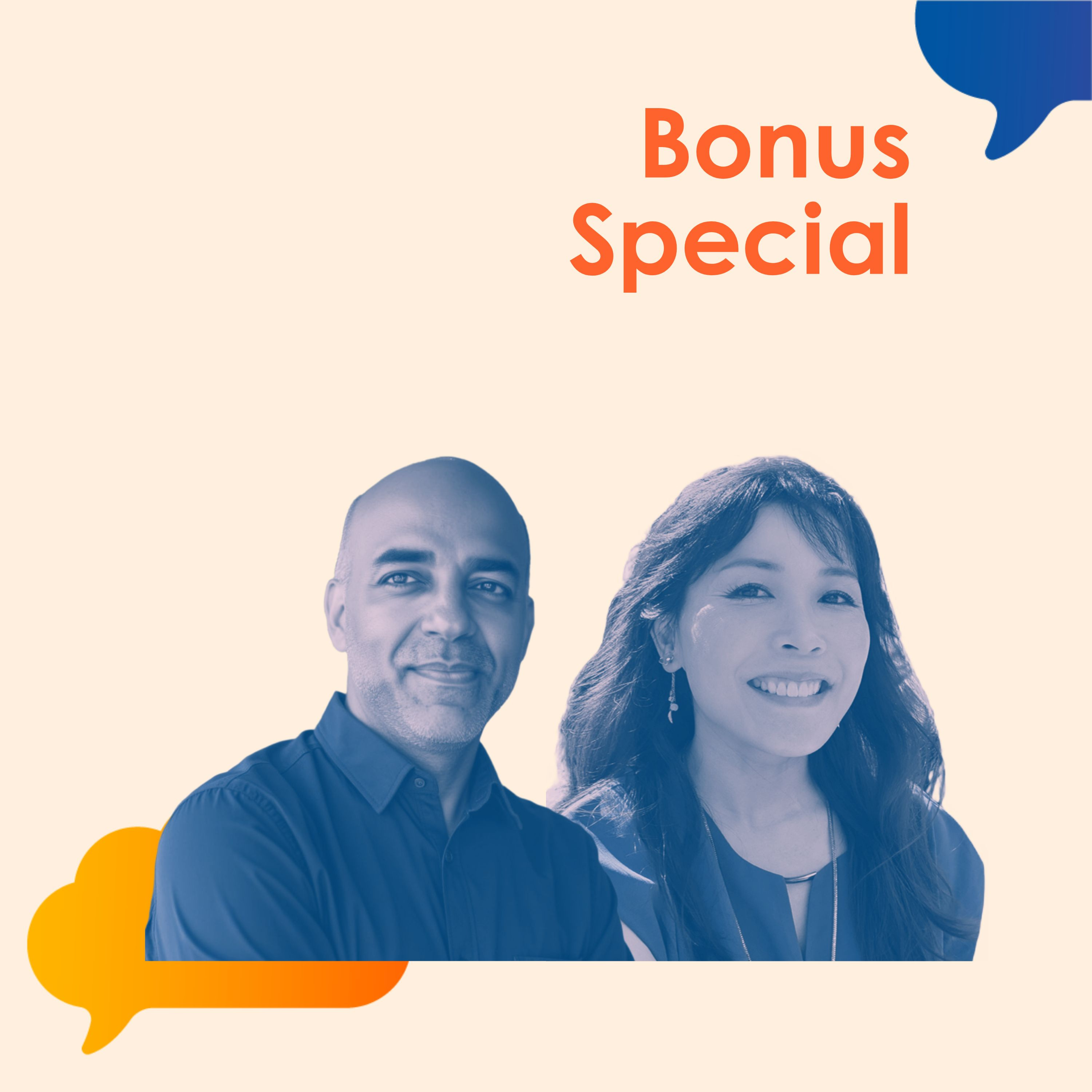
Bonus Special - The mic flips. And so does the perspective. Karen Chong & Sai Ramachandran
About This Episode
The mic flips—and things get a little more revealing.
In this episode, Sai Ramachandran puts Karen in the hot seat to explore what’s behind Mind Blend: the way she thinks, the questions she asks, the experiences that shaped it and what’s coming.
From growing up across cultures to navigating a career as the “connector” between different worlds, they unpack how those experiences led to the creation of the show—and the thinking behind it.
From not fitting neatly into one identity to learning how to navigate uncertainty without confusion, this conversation goes beyond the usual format.
Curious what’s really behind the show—and the person usually asking the questions? Tune in.
About Karen Chong
Karen is a third culture kid who has lived in Hong Kong, San Francisco, Los Angeles, Tokyo, and now London.
She naturally operates as a connector—bridging different perspectives, translating ideas, and helping people make sense of complexity. Through Mind Blend, she explores the gap between knowing and doing, helping listeners see themselves more clearly and move through life with a bit more clarity.
Connect with Karen on Mind-Blend, Instagram Mindblendpodcast or mindblendpodcast [@] gmail.com.
About Sai Ramachandran
Sai was a previous guest on the Episode, Punchlines and People Skills: What Comedy Can Teach You About Engagement, and the one who decided to flip the mic for this conversation. Check out that episode to hear more about Sai’s comedian journey.
An engineer by training, Sai approaches humor from first principles. He is the author of Humor Science: When Your Success Depends On Being Funny And Engaging and works with CXOs to help them communicate with more clarity, engagement, and empathy.
You can connect with him on https://linktr.ee/sai.humor.scientist, Instagram: @abeysai YouTube: @sai-ramachandran
Watch his sketch: My Name is Bald. James Bald.
And TedEx talk: Engineering Comedy
0:00 Hello everyone, welcome to another edition of Mind Blend, the broadcast about real experiences and meaningful conversations usually hosted by the inimitable Karen Chong. But today's episode is a little different. It's an inside out, upside down episode. Hunter becomes the haunted and the asker gets asked questions is in this episode. We put Karen on the hot seat and I, your host Sai Ramachandran, get to ask her questions. But first, a bit about Karen. The frequent listeners of this podcast may or may not already know Karen is a self-described first born daughter and a third culture kid, which explains a lot about what she excels at, which is to serve as connective tissue between left brained engineers and right brained creatives and strategists.
0:48 She comfortably holds the big picture in her head while being detail oriented. And I have personal experience because I was a guest on the podcast not so long ago. With that, welcome our guest for the day. Also the host for all of the episodes in Mind Blend, Karen, John. Hi Sai, thank you so much for that intro. All right. The question number one, you've lived in multiple countries and cities and you're a third culture kid. My question is basically from my own ignorance, what does it mean to be 1/3 culture kid and what can you tell us about being a third culture kid?
1:27 The quick answer is you're not attached to just one thing. You don't really fit neatly into any box. And the questions that I get asked a lot, where are you from? I just came back from South Africa and people ask me where are you from? I really don't know what to answer 'cause I think the most relevant may be, oh, I came here from London, 'cause they're probably asking about like, oh, where's this visitor from? Like for example, if you're taking a survey at the monument, for example, they have a survey.
2:00 They probably just want to know where are people visiting from? They're not interested in my origin. But then clearly I told them of London. People may think more like, oh, where are. You do they ask you anything? Sometimes, not all the time, not so much anymore, but like, oh, you don't have a London accent? And then I have to answer, OK, I moved to London from San Francisco. If they're not really familiar with how there's like generations of Asian people in the US, maybe they'll ask another question.
2:38 So I really don't know what to tell them, 'cause it's like, do you want to know where I'm born, where I grew up, what passports I hold, what language I speak, where I'm living now? So I think it's that that's my answer. Alright, so so my question to you is that you say you're a third culture kid. You have experiences from many parts of the world. You don't know how to answer the question of where you're really from. Does that, how does it make you feel when you see someone who's very comfortable in their own skin?
3:04 Does that first of all make you feel a little bit intimidated when somebody super familiar, super grounded in where they're from? Is that, is there anything which comes to your mind when you when you meet someone who's like, yeah, yeah, I'm from, I don't know, some part of London that I've grown up there for the past. My, my has been there for the past 100 years. Does that make you feel it? Yes or no, let me let me tell you about the when it doesn't intimidate me because I don't see myself like permanently in one place.
3:34 And if I am living, working in the place that I was born and have never left, and I'm not talking about just travelling, if I've never left, I don't think I will feel very fulfilled in my life because I do know people like that. I knew them from school. They are still living in the same area. They marry people from the same school and their kids are now going to the same school. So I don't feel like I'll be very fulfilled. So this is when it doesn't intimidate me. When it does and it's more like I, I'm envious of them is let's say the tour guide in my trip recently, he's a local and he's been there his whole life.
4:18 He even showed us the house that he grew up in. And I'm jealous because like, he knows the city in and out, 'cause if I say, oh, I want to be this local guide, where do I feel comfortable saying I am the local 'cause I'm not really a local anywhere. I've lived in San Francisco and Hong Kong the longest, but I also don't feel 100% qualified to be the local guide like for the time being, local guy, but it's not like I have 50 years living in this place. So that's one career that you're not going to get into, which is tour guide and moving people around cities.
4:54 So that's one career option off your list. Yeah. So Speaking of careers, you've been a project manager, you've been a connective tissue, like you said, between the left brain engineers and strategists. So what have you done? Bring us to present day Kat, and how did it start? How did it get here? Let me let me think. I think all most of my jobs have been just being the one in the middle coordinating different parties like my first like relevant jobs to this. I was a product development coordinator.
5:25 So the company makes figurines and they have factories in China. And so I work with a product development people, the designer in US time zone. And then that was many, many years ago. And at the end of my day, I'll have to send an e-mail of like all the developments. So like, OK, for this product do this, this, this, this product do that, people in China do that when they're sleeping next day, come back, continue the development. So it like this connective tissue started with that. And my like, exposure to different culture helped me because I'm able to just make it really simple for them in China, like, you know, designers have like fluffy languages, but I don't need the fluffy languages.
6:13 I just need to tell them, OK, make the hand like 2 centimetres shorter or something like that, right? I don't need to tell them the emotion this change needs to evoke, right? And Fast forward, I did a lot of different things in between, but Fast forward, when I moved back to Hong Kong in the late 2000, can you even say late 2002 thousand, like 6:00-ish, seven time frame, I got a job at an advertising agency. So I was an account manager and it was like an international advertising agency. So most of the clients, they're based like they are physically in Hong Kong, but these are like multinational companies.
6:57 So it's again very international like, well, the clients are local Hong Kong people. Their counterparts are the English American, you name it. And this is when like language in terms of just like Chinese, English and language in terms of like pragmatic and visionary, the evil bridge that is important because again, the people we need to execute, like the designer, the web developer, they just need to know like, OK, what do I need to change? So I'm going to assume that the the translation was similar, like move the hand to centimeters, make the hand to centimeters shorter.
7:35 I mean, I'm assuming that the figurine makers and the ad creative designer needed that level of detailing in both jobs. Would that be right? For a very, very experienced, say, art director, I I didn't need to give her that level of detail because she's not just an execution person. She's the one who like bring vision to art, like how it actually looks like. But for anyone who's less experienced, yes I will. I will need to tell them to change the color from this hex code to another like something like that.
8:09 After that, basically all my jobs have been core. Like the title is project management, program management, and it's similar 'cause I have worked with people who are very visionary, very creative and people who are engineers or designers or they need to produce something they need like really clear what do I need to do type instructions. So, so I'm curious, OK, I'm I'm this, this is making really curious. Do you have any grounding in art for for you to be able to say I'm trying to evoke to to create this feeling of awe in my audiences.
8:46 So for that to be translated into this person should look a certain way of be positioned in a certain way that must be needing some sort of training. So do you have any training in arts? Do you have any training in executing vision? How is it that you're able to translate? Because that seems like it's a, it's not an in it's skill. You have to be taught these things. Yeah. So even this, I'm sort of the in between because I have no formal training in arts, I have no formal training in engineering, but because I have worked with these people enough.
9:17 So if I think back on when I first started, of course, I didn't start with knowing how to do these things, but I asked questions like I asked the people who need to execute, what kind of information will you need to know to be able to go to the next step? And then for the visionary, like I just try to listen to what they're saying because like for the visionary, it's a little bit easier to understand because it's not really engineering. You don't need a degree to understand arts. And I don't do the art direction, but I use what the client has said, what the creative director is proposing, like see if there's any gaps in between these because the clients are people, The clients are like business people.
10:01 So if I can bridge that gap and by asking questions, you know what the people who execute me to know, then that like kind of helped me stay afloat. And over time, you just kind of know what the designers will need to know in order for him or her to design something. Now you ever tell me this, has it ever happened that the art director or the person with the vision, I don't know what, what term, what role they play, but that person said, do I want this, this thing to be conveyed through the product?
10:32 The product final part should convey this emotion. And you're like, this is not going to work. Let me inject my own two cents or let me tweak it a little bit so that it it so hasn't that happened that you had to give some you added some your own some secret sauce from Karen Chong's book of secrets so that the product became nicer, better sold better, looked better. Is that did it ever happened that you super you overrule the art director without them knowing? I have definitely injected a normal person's point of view.
11:04 So, for example, this didn't come from the creative director, but it came from the client. We were making a billboard and the client wanted me to add a paragraph to the Billboard. We're talking about a long paragraph in a billboard that people would drive by. Anyone will know it's not meaningful to add a paragraph on the Billboard unless it's a disclaimer that you're forced to put in there. And same thing for the creative. Like I would tell them, OK, the client wants to achieve this purpose. Can you explain to me how this creative direction is achieving that?
11:40 So by asking these type of questions, I'm not over ruling their creativity, creativity, but I am grounding them like, yeah, matching them to what we're trying to achieve by applying like thinking of how it's going to come across, thinking of how it easily looks like in life and just making, making sure that it's on the right track. I think that's more of what I do. So, So why podcasting? So you did all these things. You were part of an advising agency. You helped translate the vision into a product that sounds like, you know, market focused B to C sort of work.
12:20 Why podcasting? Why a podcast like Mind Blend? Let's transition to that and tell us more about Mind Blend as a product, how it came about. What made you commit to this? You've been doing this for how long now? How many episodes? A. Year. A year, yeah. Like it's January 15th. Last year was when the first episode came out. So. So what brought you to podcasting and why you've done it for a year? A year in podcasting is a lot. There were a few things actually like there I am very much a person who believes in teach people how to fish and given our world now, the soft skills are very important.
12:58 And the soft skills that are important are the EQ like reading the room, understanding your audience, being able to communicate clearly and problem solving, like analyzing things not, not just from like a scientific mathematical point of view, but just don't take things at the surface level. Like I think these are very important for anyone to live a more fulfilling life or even just not go about life blindly because that's something that I have been very against even from a very young age. Like, OK, you're at this age, you should be doing that.
13:40 Like that life timeline. There are many people who are just following the lifetimeline and they don't really ask why, like ask themselves, do I want to do this? Or yes, I'm at the age that I should be doing this, but how does that align with what I really want out of this life? So I think the fundamental reason why I want to do, why I want to spread information is that there's a lot of directions I was considering before, like how to do right things right? It was one of them. But what's right is very subjective.
14:18 And just because this person said it's right doesn't mean it applies to other people. So I was like, OK, that's not exactly what I want to do, but like, how can I equip people with knowledge that kind of helps them think deeper or open up their minds a little? I think that's why I eventually landed with Mind Blend and then why I wanted to do a podcast. It's because like I did an internal one at the company that I was working at. It's not related to like Mind Blend topics at all. It's just interviewing a few members in the company employee network group and just understanding their experience.
15:01 It was an Asian American employee network group. So like asking them about Asian American experience in the States, things like that. I was the one person doing everything, but I enjoyed the process so much Like I, I thoroughly enjoyed. I spent a lot of time that was my first time doing any sort of like recording and then editing. I was doing everything. But there's zero part of me that was complaining like why am I doing? Like, why am I the only one doing everything? No, like that did not come up at all.
15:34 And someone after I did the internal podcast, I was talking to an ex Co worker and they said, well, maybe that's your true calling. So like that planted AC. So all these combined made me wanted to do a podcast. And with the first episode I used to work with that person, that guest Juan Silvera. And then because he's a marketing guy, at first I was just going to do an interview and post interview somewhere. But because he saw like more potentials, like, oh, there are more legs with this project, why don't we do more with it?
16:08 So that became the first episode. So in the last one year, let's go back to the to the last one and then we'll talk about the future. What are the kind of guests you got? Did you always get the kind of people you you were looking for? Or did you have to say, you know, fish around among friends and say, hey, man, can you do a episode with me? Because I'm, I don't I can't find anyone this week or this month. So how was it? How's it been this been this year, this past year? So thank God there are platforms that matches guests with shows.
16:34 So I have gotten a lot of guests from a platform that are used for that purpose. In this coming year. I have some topics that my friends and listeners have requested and I was recommending another platform where you can put a topic out there and then there can be people pitching to answer like this call that source is giving me more knowledgeable guests. But now like I think because I want to go deeper, I want people who have like spent extensive amount of time researching the topic or they have more authority in whatever domain I want to talk about.
17:12 So finding guests hasn't been all that difficult thanks to the platform. So can you give us the preview of the kind of topics we can expect in the second year or is that the secret? Is that a secret? Like to summarize, like how can we let go of like, how can we let go of our past self? People have been saying the world is changing for many, many years, but the world is changing very rapidly right now. No one is able to just carry on their own self and keep going. So I think that's one big theme, OK, and another one would be more.
17:52 I will continue on the like understanding yourself better theme because I think there's a lot of value in that. And of course, like a lot of brain, like how our brain works, that will still be another theme that I keep exploring. Now, if I was your friend and you would ask me, like, listen, suggest some topics to me, I'd be like, you know what I want to know about, you know, life after death or something like that, like this. Talk about it is is there anybody who's that like something? Completely.
18:22 Yeah. I'm not surprised because I did have some like spiritual leaders who approached me. So yeah, OK, I'll put that in my list of ideas. All right, so, so in the last year, most, most the guest you learnt the most from and the one that you were most excited to have on the show. And are they the same person in the past year? You were definitely one of them because I have really wanted to talk to comedians, like even from the beginning. So you were definitely one of them because I personally love comedy and I do think there's a lot, there's a lot of like science and EQ involved in being a comedian.
19:06 So you were definitely one of them. And I learned a lot in the brain wiring episode with Doctor Loretta Bruning. And also I talked to a chef that was the second episode about Nissan Plas because Nissan Plas is another concept that I really like. What is Nissan Plas? It's basically a French kitchen term. It means like having things in place. So if you're going to make a dish, the chef is not going to do everything as he's going down the cooking process, right? The things are already prepped there, like all the work is done before, but you got your chopped vegetables, you have your sauces, you have your pans and pots, those type of things.
19:52 And that concept can be applied to daily life too. Because I read a book that talks about exactly that, how to apply me some pots in everyone's daily work day. And it makes people like you don't just go through your day like rushing from one thing to another, but you have control over your day. But wouldn't that mean having like 20 people in your employment or doing things for you just to get you to a place where you can put things together and execute? Not literally, but you yourself have to do more prep work so that your day can be less chaotic.
20:30 So for example, if I were to apply means on pause in my day, it would be like starting the day, looking at what you need to achieve and say you have a morning meeting that's more like progress, stand up type meetings. And then the next thing you have is like maybe leadership facing meeting. And then you have one hour, maybe you can have for lunch or something. And then you have to go, you have to run errands and you have to go out tonight, for example, But you have a proposal due tomorrow. So looking at what you need to do.
21:10 So this is sort of like thinking of the dish you need to make and how, what, what can I do before and after enduring that can help me achieve all of these and achieve all of these with standards. So like maybe instead of just starting the day with that progress meeting, maybe even start yourself earlier. Like look at look at the progress, think about the questions that people are going to ask during this meeting and then doing some studying or research or like get your information together. The leadership basic one also like mentally preparing what you need to answer or like think, think ahead.
21:52 I think that probably would be the closest is think about what the outcome needs to be. And when you're doing this, you are already thinking of the how the final product should be. So yeah. Something similar when it comes to say working out and running. Also because I've, what I've, what people tell me is that if you want to go running in the morning, the first thing you should do is put your running gear at least within reach or you should be. You should go to bed wearing your running gear so that when you wake up you have no excuse not to go running.
22:22 So it's something. Like that? Yeah. So you just have one step ahead and push, you keep pushing yourself towards where you need to be. That's great. That's. Yeah, and not being reactive. Right. So last year was the chef, then the doctor, you said, and myself and a few other guests of yours fighting to you. So what about the coming? Is that like if you had if you picked a name out of a hat, you had a hat full of people that you could have called who who you will call in the future. And you said, I'm going to wave a magic wand and call this one person.
22:53 Who would that be? You have only one name to pick. You can you cannot say I'm going to pick these five different people, just one person who if you could get them on the show, you'd get them on your show in a heartbeat. Who would that be?
23:05 That's very difficult because I do plan on reaching out to both of them. I'll pick this author. She's a psychoanalyst turned author. Her name is Philippa Perry. So I read her book, the book you want everyone you love to read and maybe a few you don't. I think she had a column in a newspaper and then she receives readers letters and her she helped them, she answers their questions. But she also goes into a lot of the deeper like psychology type things and everything she said in the book. I'm like, that's what I've been saying for years.
23:45 I'm not saying like I'm as good at her, but these are a lot of these are common sense things that people don't think about. And I think one reason why I want to equip people with knowledge so they can go about life better is a lot of things are common sense like you, because everyone is in their situation. You're blinded by the situation. And then when you're the outsider, it's crystal clear what this person is doing is maybe not the best thing for them. So Philippa Perry would be the person. I have two questions.
24:20 Do you genuinely think you, you've said it twice already that you wanted to equip people with enough knowledge to help them live their lives better? Do you genuinely feel that teaching someone how to live, teaching someone anything is even possible? I mean, I know you can teach people ABC because we all went through school and learnt ABC and maths and all that, but stuff like how to live life better. Is it even possible? Do you genuinely believe that? Or you at least want to create the knowledge and let them find it whenever they're ready?
24:48 I'm I'm always conflicted by this. How? How much can you teach someone, especially as an adult? How much can you teach someone how to live their life better? Teaching people? Absolutely possible. Changing people is not possible because a person will change only if they want to change. If they're changing because someone else told them to, eventually they're going to break the rule or go back to their own self. But by teaching them, you at least expose them to the information. And it all depends on that person.
25:24 If the person him or herself have no desire to even take in the information or they're completely closed minded and don't even, it's like a like nothing penetrates. There's something you can do. But if the world is already filled with negative fake media, why not spread like more accurate factual information? And in what I'm doing, I'm training AI to spread factual information as well. So teaching absolutely what how effective it is. It depends on the person. And also a lot of the episodes, it's not so much like it's not black and white and only black is the way you should go.
26:12 It's not like that. It is. These are the colours. This is how your eye will react to this colour. And in this situation, like when you're about to go to bed, a white light will affect your sleep quality. Yellow light will help. So it's more like that. I'm not saying red is better than yellow. So yeah. So the, the other question that I wanted to ask was why Philippa and you sort of answered it then, But beyond that, like what were like, what are the some specifics that she was talking about that he thought was really important for more people to hear about?
26:50 Like maybe one or two things from that book, if you could share that. She talks a lot about the things that are related to her psychoanalysis work, and because a lot of the things that we are struggling to make a decision on, you actually do know what the decision should be. I remember one of the letters that she received from her readers. It seems like I'm really attracted to this person at work. But I have a loving family. My wife is caring, things like that. But I'm like, we haven't done anything yet, but like, we're just close to doing something.
27:27 Like what should I do? And then she kind of reframes like she's not saying adultery is wrong, but like she's reframing. But do you want a life partnership? And by committing anything with this other person at work, what you have at risk? And so she's not saying you should not cheat. That should not cheat. But like, think about what you want, because if you ask that question, if this person still carry on doing what the animal instinct drove him to, then you know it's your choice and you're putting your partner, you're putting your marriage at risk.
28:08 If you're willing to do that. Well, maybe some there's something about the marriage, maybe you are not really committed to this marriage anyway and it may fail eventually down the road. But I think this aspect of how she analysis the situation and give people advice I that resonates with me a lot. OK, so now the your choice was a person who I'm, I'm not sure many people know about Doctor Philippa, right. I was expecting you to say Barack Obama or someone like like a global person like that. Is, is, is that a reflection of how you are as a person?
28:44 You, you look for mentors and, and sources of knowledge more accessible to the regular people. Or are you like, what's your social media consumption like what, what, what, what do you look for when you're thinking about what to talk about next? Or I mean, I know you talk to your friends, but like, how do you, how do you inspire yourself? How do you Orient yourself in life? Those are a few questions in there. I think I am very like educational, like deep down I'm a nerd Right now there's this one social, one Instagram account that I recently discovered.
29:18 I love it. So it's animation, but it's animation of simple things in life like the tips and not even hacks, just like tips. So it's like if you have a super hot pan, don't put it in like cold water or like when or don't put onion next to avocado or something. So it's I, I want people to know to navigate life and to live a more fulfilling life. If you can understand yourself, if you can apply the same psychoanalysis to yourself, it helps you avoid a lot of like confusion. Confusion is one of the emotions that I hate the most.
29:58 I want people to stop being confused with life. And one way to not be confused with life is like, have a very clear vision ahead, at least for yourself. Like you can't control anything around you, but if you know what you want you will pave the way for yourself to get to where you want to go. But but you lived in say 5 or 6 different cultures, different cities, and you have had to deal with not knowing anything about a new place you moved to, You moved from London, from San Francisco to London, London to Hong Kong.
30:34 I, I know you've been to Japan, you've lived in Japan, even in South Africa. And also long ago you are intentionally putting yourself in places. But confusion is your state of being. But now you're like confusion. You need to reconcile this for me. So confusion and uncertainty are different. OK, Confusion and unknowns are different. So let's say before I move to any country or before I go on a trip, I research everything I can. Like I research the basic things like the voltage, what adapts are I need to bring currency, it's credit card accepted like the things that will keep me alive there.
31:10 And with Internet nowadays our smartphones so much easier. I just need to know like the major things like, you know, get my SIM card type thing. So I prepare. The unknown would be how is it actually like when I'm there? Like it's crossing the road exactly like how it like the Internet says, like when you're in Rome, just follow the Romans. Otherwise you would never be able to cross the road. You know, things like that. You don't know until you're there, but at least you have an idea of this may come up and language, like maybe you learn a few phrases here and there or get the translation app with the local language downloaded already.
31:49 And yeah, so the unknown makes life a little interesting, first of all. And it's not my first time going to his destination that I don't know of because I've done enough of that. I kind of know how I should prepare. And like, what are some like safe moves universally? Like universally there's some safe moves and just be safe. I err on the safer side of things when I'm travelling or when I'm in unknown situation just to like keep myself alive. So yeah, does that answer your question? Confusion and unknowns are different.
32:23 I what I'm hearing from you is that you don't actually give too much space for not knowing what's going to happen to develop. You do your research, you sort of get your apps downloaded, you have your currency in your pocket, you make sure your phone SIM is enabled and data roaming is turned on or whatever those things are supposed to be. You, you do everything possible to keep yourself alive and safe. So it's like, it's essentially like you're going to Six Flags and you're on this roller coaster, but you you make sure you're strapped in, make sure that that steel cage you're inside is not defective.
32:59 I don't think I. Think and then you need. To make sure it's not defective. I'm at the mercy of the people there. We. Just hope that you know, it's been inspected recently and you know, steel cage that the one they put you inside the harness and everything it's all done. That sounds like this that your life is also like that. You're not really really, really going completely off the off the reservation and doing something crazy. Just doing enough to get that sense of going going to any place. I understand.
33:25 So OK, cool. So now the question about podcasting, your domain right now, apart from your work is podcasting and you're trying to share knowledge. But what kind of podcasts do you listen to? What kind of people do you admire? Like specifically podcasting? Do you listen to other podcasters? Do you listen to other? Do you look at them and say, oh, you know what, this is really cool. I should I should try this on mine? Yes, hidden brain is when I listen a lot. I think mind blind is influenced by hidden brain.
33:52 I really like what they dive into and there's a lot about like how your brain works, how emotions work and things like that too. The hidden brain, which is like, that's why I said I'm a nerd 'cause I love listening to things, that I am gaining something, I'm learning something. So hidden brain is one of them. I'm trying to think if there's any. I listen for fun. There is, but there's also this underlying learning. So two other ones are related to Japan. One is called Abroad in Japan, so Chris Broad is the person, and I've read his book too.
34:30 So basically he taught English in Japan and just stayed there. He didn't come back to England and he started a podcast. The podcast is for people who are interested in life in Japan without living in Japan. So I listened to that one so I can kind of keep in touch with what's happening to Japan because I lived in Japan a long time ago. I still go there. I still talk to my friends, but new things come up right. So I don't want to be like super outdated people know exactly like, oh, you were here in the 2000, early 2000 type things.
35:06 They'll kind of to keep me in touch with Japan. The other one is a Japanese podcast in Japanese. So this person, he lives in Mexico, he teaches Japanese in Mexico, but the podcast is not like language podcast. It's just him talking about various things. But I can practice listening so and his topics are actually really fun as well because it's day-to-day things, but there's like cultural involved there. There's, you know, life in Mexico. He even shared an episode like how to be efficient in taking a shower in Mexico because you only get water for three minutes and it's not 3 minutes of hot water too.
35:51 So like stuff like that. I learned vocabulary. I learned because he talks about things in Japan too, when he goes back home. So. So these two are also like Japan related. I feel like if I'm not learning something and I'm just listening to something for fun, that's the minority of my media consumption. Yeah. You're doing podcasting. It's been starting in second year. Is this going to be podcasting? And then you're going to become a build a media empire around it. You're going to have book coming out of it.
36:23 I where do you see this? Where do you see this going after, say, five years? If I want to be useful to society, then I do want to publish a book based on the things that were talked about on the episode. And because right now it's just year 1. So I have many different facets of information. Not really something that has a clear direction yet, but I do want to use the content to publish a book of sorts down the road. And media in part, I don't know, because with great power comes the great responsibility and.
37:00 You're choosing to teach people how to live life. That's that's the, that's the maximum thing already. Yeah, I I do want to be eventually like yourself, be on Ted X or Ted. Speaker That was actually something that I thought about before the podcast, but I was thinking, yes, I'd have knowledge of many different topics. Do I have in depth knowledge about any topic that I can give a speech about? Maybe not yet. So that's why I didn't pursue that road. And so where does the audience come from for your podcast, Nick?
37:37 Is it all the UK or is it global? If it's global, which other countries do your listeners come from? US is the biggest market and I think it's because I started it on more LinkedIn, like I started promoting it more on LinkedIn because it was set up to be more professional career related. So because if you look at user base, of course US is the biggest user base of many, many different platforms. The US, the second one is UK. India is actually up there too. And Hong Kong. So mostly because of my connections.
38:13 And then I have like a lot of other countries, Germany, Japan. What is the strangest one? I, I have some, I think Estonia was one of them too. So brand like very geographically dispersed. I think South Africa was another one, but that was probably my friend when she was visiting South Africa. Australia. Like countries that can understand English at least. Yeah. And then like, guests come from everywhere too. So where the guests are from, there will be some listenership. So which is the most out there country from where you've got a guest?
38:48 From where I got a guest, let me think Mexico. But she's just living in Mexico though. Yeah, I would say Mexico, but something, something else may come up. Right. So if there's one country that you'd want a guest from, like if I was doing a podcast on thing I'd like Afghanistan, that'd be a country like you'd never expect a podcast guest from Afghanistan saying here's what you can learn about life in Afghanistan. I'd love something. Is there any country like that in your mind that I wish I could get a person from there?
39:16 Right now, probably Greenland, Right now, probably Greenland, because it'll be interesting to hear their perspective. I don't. Think you need to go to a podcast? You have to know. Because what we see in media is filtered by the media, right? So either Denmark or Greenland. That's that's a good one. That's a good one. That's like. Unexpected there because I did hear different perspective, like like how Danish people think about the situation, how Greenland people think about the situation. So yeah.
39:52 Like they're not the same. I'm I'm assuming when you said that the they're not the same. So the, what we see on media, but what I, what do we see in media is a Greenland people are saying like we are our own country, like, you know, we need to decide. And then for Denmark, we see the perspective of Danish government, right? But whatever the person in the South Africa trip, she lives in Denmark right now. And then she said, if you ask any Danish, they'll just say take it because they're paying taxes to support Greenland.
40:23 So for a Danish citizen. They're just spending money on this place that they they're not gaining anything from. But from the government's point of view, there's like natural resources, but of course, citizens, that's like when they're removed from citizens. We have never heard this perspective before, right? So that's why. So maybe your your next niche could be correspondence from troubled spots in the world. I don't know, like things that people didn't know, but uncovering things that people don't know.
40:55 OK, so now one last question about podcast business. There is a lot of stuff that is not English. Like there are a lot of, there's a lot of intrinsic knowledge in for for example, the Amazonian people and the Greenland people were not maybe conversant in English. Do you worry that, you know, there's some stuff I'm not able to expose to the world because I don't speak the language? Do you have any such ideas and how to bring that knowledge out? 100% because it being an English podcast, my guests and I are limited to certain world views.
41:27 Because if you think about all the English speaking, not even just English speaking countries, like English speaking countries will be Australia, New Zealand, India, USUK, Canada. Those are the ones that I can think of. We're already self selected. So I thought about doing something in Cantonese and Japanese, but I would have to kind of segment out the episodes because it's difficult for it to be multi language in that way because like not all my listeners speak all three. So I did think about that.
42:01 I don't know, I haven't really thought about how I can bring the information out. But one way would be eventually opening up a channel for people to write to me. And then I look at this topic and find out as much as I can. And maybe instead of conversing with her, this person, because they don't speak English, maybe some other way like Britain, or by that time the live translation will be more advanced. So that would be possible, yeah. Have you had a moment when you're like, you know, I'm actually arrived this Has there ever been a moment in the last one year where someone like.
42:38 Oh, you. You. Karen, I I listen to the episodes all the time. Or do you want that to happen? Yeah, this moment when you're like. Yes, like it was provoked. So one of my top, top fans, 'cause I had a poster printed and then he said something like, oh, I'm like, I, I'm waiting for that signed poster of yours. So I did send it to him, and then he framed it and sent me a picture and said, like, I'm waiting for the day where someone sees this in my house. I go, oh, that's a great show. I listen to it all the time.
43:11 So that made me want it. Yeah, Yeah, of course. And do do your friends look up to you as this Yoda kind of like a super wise person who knows everything because she she to so many people do they come to you for advice? Like how do you deal with this? Yeah, they come to me to like just have someone to talk to. Usually it's to have someone to talk to and they because I'm I'm impartial when they are just looking for someone to listen to and they think I am like there's this type of TV programs like science program or health program.
43:51 So and then it I think it was my sister. They're like talking to you. It's always like watching those programs. It's never just chit chatting. There's always something like factual that you could tell them or like if we're talking about coffee and then I may say, Oh, you know what, like say Ethiopia or like the least developed the country. It's the more organic it naturally is something like that. So, so you're saying like if people come to me for advice, yes, all the time because I I give them what they need to know to make their own decision.
44:29 Your friends was like, wow, talking to her like it's, it's it's like like it's just said watching that educational program. So do you feel, do you feel constrained in the amount of small talk you can make? Do you feel that maybe if I, if I could just lose that nerdiness of mine and become good at small things, have been better? But do you, do you feel that? So I don't think I'm bad at small talk. Like I it's not in my nature to do small talks for 30 minutes and do serious stuff for 10. Like I will do 5 minutes of small talk and then get into business.
45:06 So I don't think I'm limited per SE. I don't always try to teach people things because that will come across as mansplaining. I, I'm sorry you're a man, but it's just, it will undoubtedly become that. So I also don't want to be that person. So I kind of like limit how much I teach when I'm talking to that person. But yeah, like I feel like more like a therapist 'cause they don't really answer you right. They just ask you a bunch of questions. Yeah. So I think it's that. But do you think, I mean, again, back to the podcasting, do you think that is the right thing to do to just create the atmosphere when you're in within which your guest is able to completely answer the question to the fullest extent possible?
45:52 Or do you feel this urge to direct them in a certain way or any of those things? Like there is a lot to be taken in and then we as the listeners have to filter out some of the stuff that we don't want and say, you know, I'm going to focus on the stuff that I do want, which is a little bit like a, you're not boiling it down to that little nugget of stuff that I can use because I have to listen to a lot of get rid of some stuff. So I'm just thinking about that's how it's going to be that you have all this other stuff that I need to listen to just to figure out the stuff I do want to hear.
46:25 So because every episode, because I'm not, I don't know what the situation of the listener is, right? So every topic, every episode talk about stuff with the guests, but I usually have questions like, OK, in real life, how does that look like for someone who's not in this field at all? How can they apply it? So at least there's a little bit more practical how this information is useful to me because like, it's really easy to lose people if they think, oh, I'm not in leadership. So this episode about leadership, not relevant.
47:02 But there's also things that they can take away from what we talk about when it comes to leadership. Maybe it's not about how you yourself be a better leader, but how you can look out for bad leaders and try to find better ones to follow, you know, things like that. So I try to make, I try to add practical aspects to it. Yeah. Cool. So I think we've spoken for what for about an hour and it's been leading conversation. We've learned so much about Karen, the person who was helming Mind Then for one year and now she's just for this one episode.
47:38 She agreed to be on the other side of the table and answer questions for us. You've learnt about her journey as a child in various cultures, as an adult experiencing different cultures, how she thinks about experiencing different cultures, how she appears to a sister who thinks that she appears like ATV Show. That's interesting and the kind of stuff that inspires her, the stuff that she likes to listen to. So this was an an exceptional conversation with you, Karen. I'm so glad we had the opportunity to actually do this and put you on the hot seats.
48:06 How? How does it feel to answer questions and not keep asking questions? Oh, like it. I have to dig deep. I have to dig really deep because I feel like my thinking like even though I'm my job is to organize information, right? But when it comes to my own things, the thinking is like very jumbled there. It's never black and white. It always depends on something. And then I know I want this, but maybe instead of just going one straight Rd. it's like this. And then I get there like when it comes to my own things.
48:39 So it's kind of interesting. I'm not a Gemini, but I feel like I'm Gemini in certain ways. So yeah, are. Are you, were you born in some sometime in May or something? Is that why you're saying I'm Gemini? No July. So I'm a cancer. This is the most animated you waving your hand around. That's the first time I've seen you so animated about in. Oh really? I do that a lot actually. It's nice. So it feels energetic to be in the hot seat. Thank you. Thank you for this idea. OK. Cool. So I think thank you.
49:10 You want to stop recording? So that was me, your host of Mind Blend, Karen Chong. Thank you for listening to this Inside Out Upside Down episode with Sai Ramachandran. I hope you enjoy this one today too. And if you do, follow Mind Blend and spread the words. Bye for now.

 Spotify
 Apple Podcasts
 Amazon Music
 Castbox
 YouTube
 Castro
 Goodpods
 Moon FM
 Overcast
 Pocket Casts
 Podbean
 Podcast Addict
 Podcast Republic