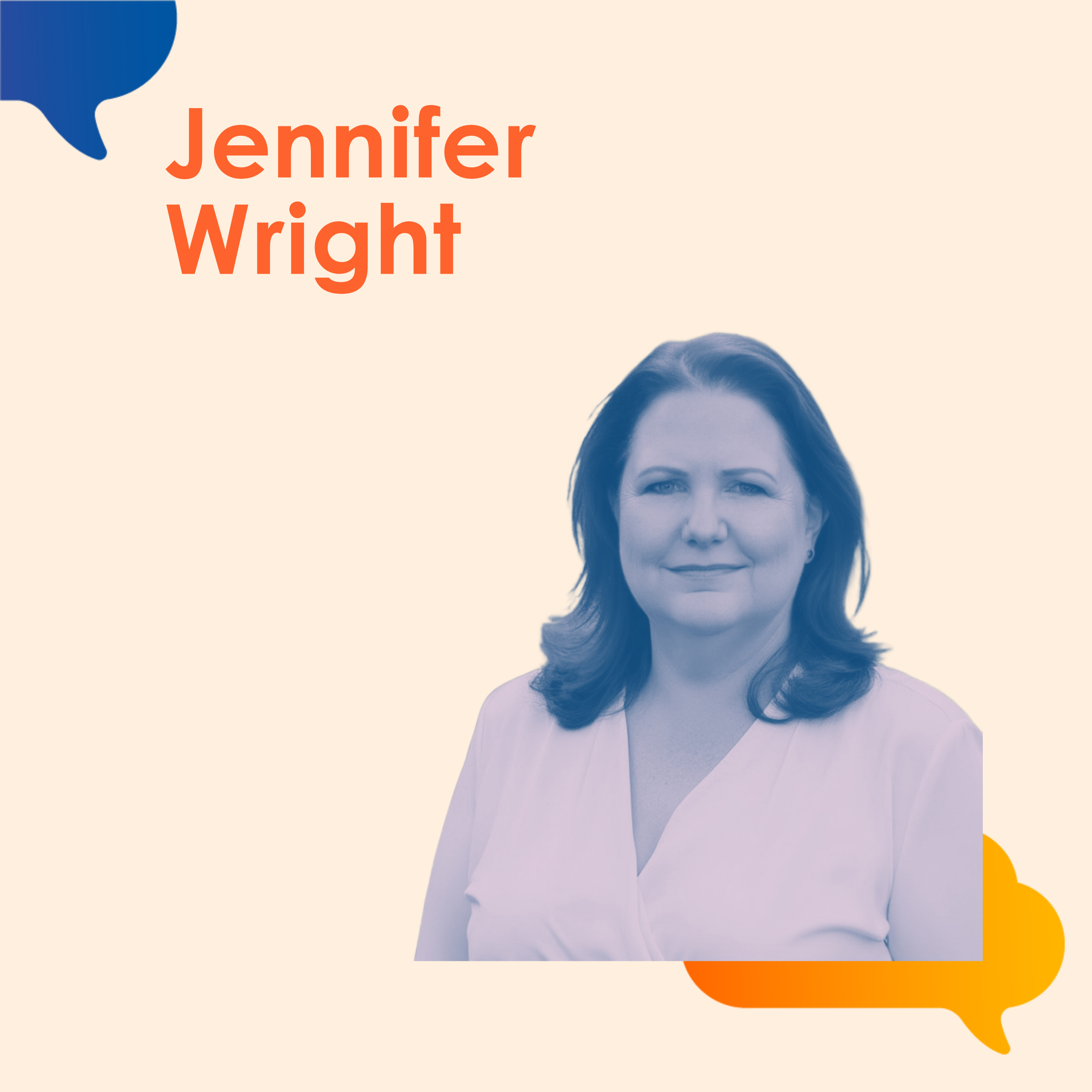
When you write, you think better: The untold benefit of writing - with Jennifer Wright
About This Episode
Writing isn’t just about communication—it’s mental training for your brain. In this episode, author and leadership coach Jennifer Wright shares how writing, especially pen-to-paper, can sharpen cognition, boost memory, and even help us process emotions and trauma. Beyond being a creative outlet, writing strengthens neural pathways, enhances learning, and fosters self-reflection. Jennifer also talks about overcoming writer’s block, finding your writing rhythm (whether you’re a “outliner” or a “pantser”), and how to make writing a regular part of your routine—no publishing deal required. From journaling to using voice dictation, she offers practical ways to turn writing into a daily exercise for your mind and emotional well-being.
If you’ve ever said, “I’m not a writer,” this episode might just change your mind. Writing could be one of the most powerful ways to boost your confidence and clarity in life and work.
About Jennifer Wright
Jennifer is a strategist, author, and transformation leader who helps executives and creators turn ideas into impact through the power of writing, leadership, and storytelling. As the founder of ExecuWright, Jennifer guides leaders to find their voice, build thought leadership, and translate experience into influence. Her work spans executive coaching, publishing strategy, and visibility consulting—helping clients clarify their message, elevate their presence, and lead with purpose.
You can connect with Jennifer on https://execuwright.com/ and LinkedIn @jenniferwrightexecuwright
Mind Blend is all about real experiences and meaningful conversations—through sharing these insights, I hope to inspire and empower you as you navigate your unique journey.
I’d also love to hear from you! What resonated with you today? What topics or guests should we feature next? Let’s keep the conversation going—connect with me on LinkedIn @Mind-Blend, Instagram Mindblendpodcast or mindblendpodcast [@] gmail.com.
Follow Mind Blend to get notified when new episodes are released!
Until next time, stay curious, keep exploring, and let’s continue to blend our minds and discover what’s possible.
0:01 Welcome to the show Mind Blend. I'm your host, Karen Chong, and I'll be diving into the minds of incredible people, each an expert in their very own way. Together, we'll uncover insights and share ideas so you can be inspired and empowered to navigate your own unique journey in life. Ready to get curious and discover what's possible? Let's blend. So most people think of writing only as a communication or content creation tool. But turns out there's more. So today we will talk about all things writing with Jennifer Wright, no pun intended.
0:40 She's a seasoned author, editor and publisher, a comedian and a leadership coach, so she shows professional how writing serves as a performance enhancement tool, essentially mental training that directly impacts your bottom line and career trajectory. Welcome to wine Band, Jennifer. Thank you. Thank you. I'm excited to be here. I'm excited to talk to you as well. So let's start with how you got to where you are today and what you're doing today. Oh gosh, it's been a journey. So I spent quite a few years in Cororate doing business rocess strategy execution, but there was always a part of me that wanted to be, I was actually a, an English major in college and I was an English teacher very early in my career.
1:28 So I, I've been a writer for, you know, as long as I can remember. So I stepped out of corporate several years ago and tried my hands at being a freelance copywriter. I enjoyed it, but that world was it was new and it was challenging. So I ended up kind of being pulled back into corporate, but I always knew that I wanted to step back out at some point and really do something more meaningful. And about 10 years ago, a friend asked me to help her write a book. I didn't know how to write a book. She didn't know how to write a book.
2:03 So we we kind of tackled it together and we did that. And then we wrote her second book together about four years ago. And then people just started showing up asking for that kind of help. I used a lot of my organizational skills that I had learned from being a business process expert and a project manager. So a lot of it was the organization of the book. It was the organization of the content and all of her ideas to pull it all together. And then the other thing that I used was my interview skills that I had kind of learned on the job as well.
2:40 So I spent a lot of time interviewing her and kind of pulling information out of her and then just getting it down on paper and being creative with it and, and putting it all together. And it was such an enjoyable process, particularly the two of us working together. We took a couple of weekends away, we called them our writing retreat and we've worked on the book. And so and then when we your second book, we did the same thing. We went away for like a four day weekend and kind of worked on it. And so it was just such an enjoyable process and such a collaborative process.
3:15 And then as other people kind of saw us doing that and wanted the same thing, and I decided I thought, you know, I think that might be something I could really do for people. So I stepped out of corporate again about 3 years ago. And since then, I've been really kind of building the business around helping people to write their books. It's helping them sort of like an extra tutor, almost a. Little bit, yeah, I take, I take a much more educational approach, although if someone, I've had a couple of people that have been interested in really kind of having someone do it for them more like a ghost writer.
3:59 So certainly could certainly do that if that's what someone's looking for. But it it's really more advice. I've had quite a few people who are looking at creating their memoirs, or they're looking at creating, taking their experiences and turning them into ways to help other people. And we look at that and we look at who the audience is, and we look at the type of information they're sharing and how they can make it better and how they can make sure that it's resonating with their audience. I know a few self published writers in my circle, like in just the past year these people have dramatically increased.
4:41 So I don't know why I see the desire to kind of spread their message. Similar to what I'm doing with the podcast. I want to spread the message and they want to write a book. So what do you think writing does to us? So I've been doing some research recently on that topic and I'm finding I sort of, I've always kind of known what it did for me personally, it's like meditation. It's a way to get things out of me that I can't necessarily say. It's a way to help calm myself when I'm feeling very anxious.
5:19 It helps with my memory. If I write something down, I remember it much more easily than if I don't. I had this idea that writing can be a mental health tool and but I didn't know exactly how it worked. And so I really started doing some research and I what one of the things I've discovered is there's a lot of data out there about how writing and specifically handed paper, like pen to paper writing, how it helps cognition, it helps learning, it helps memory. There was a study done recently, the scientists took or psychologists took a number of subjects.
6:02 They did brain scans on these subjects as they were writing. And they discovered that in the brain scans, their entire brain lit up when they were writing on paper. So it was affecting the cognitive part of their brain, the memory part of their brain. Even the parts of the brain that deal with hearing and eyesight was being affected as they were writing. So it helps so many different parts of the brain. It helps to stimulate it. The other thing it does is it opens up neural pathways. So the neural pathways are what help us learn.
6:38 So the more we write, the better we get at learning. We also learn to our spelling, improves our grammar, improves our understanding of complex ideas can improve through writing in addition to reading. So reading helps those as well. So it's there's just so many different benefits. The other benefit that's really interesting is it can help with trauma. It can. Help with trauma with. Trauma, yes So for someone who has gone through a traumatic experience at some point in our lives, we all have probably had some level of trauma.
7:22 What writing can do is help that person to talk about the what happened to them or write about what happened to them without necessarily experiencing the emotions. So sometimes when you talk about an event, I've experienced this, you've probably experienced this, you might get choked up. You can't say the words, you can't necessarily say everything that you wanted to say about the event. Writing, In a lot of cases, a person can actually share much more about the event when they're writing then they can when they're trying to speak about it.
8:05 You can separate it from the heavy emotions that you're feeling while trying to kind of relive that experience. So it helps people to actually get those, get the words out without necessarily getting kind of caught up in the emotion. So it's can be a pretty powerful tool for dealing with a traumatic event. And of course, I always believe that pen to paper writing is better because I do think that there's your brain just operates differently when you're writing pen to paper. However, if you're not comfortable with that and you really want to write on a keyboard, there is still benefit to doing that.
8:51 But, but there's, there are a lot of benefits to pen to paper writing. And as a matter of fact, when I'm talking to authors, that's one of the thing I recommend when they're dealing with writer's block. If you're trying to type and you're having a hard time getting everything out, switch over to like a pad of paper and a pencil. Or I like writing with a pencil because there's something about the feeling of the pencil that I like. It can be a pen, it can be colored markers, it can be whatever, but it can actually be a great tool to break writer's block by trying to write in a different way, like trying to write pen to paper.
9:32 It can actually free up some different parts of your brain and help you to maybe generate some some new ideas. Yeah, I can imagine just like changing your environment and sewing from physical, because there's a little bit more physical in the writing on paper than typing and the energy, the effort to draw the word onto paper, I feel like there's relationship between that and how it ingrains in your brain. So let's say if for people who grew up writing on paper how the word should look like, maybe more ingrained in their brain.
10:08 Yeah, so it. Improves the spelling because right now you just type whatever it auto corrects it for you. You don't even know that it's not spelled right, Right. Yeah, I can definitely relate to that. Like, I think now I don't think I'm able to write an essay or, like, back in school days, you have to write an essay in an hour. That's the exam. I don't think I do that anymore. Right? It's just talking to a friend because she's doing, like, grad school. And then she has to do that in the exam. And she's like, oh, my God, like, how did I do it when I was in school?
10:40 Right. So, yeah, yeah. And it is, it's also, it is a learned skill. When I talk to people about writing books or maybe not even writing a book, just writing an article or writing, you know, a smaller piece, I hear a lot of people say, oh, I've got a lot of ideas, but I'm not a good writer. And writing is a learned skill. It is not something we're born knowing how to do. The more you do it, the better you get at it. Just like if you're learning to play piano or guitar or learning a sport or anything like that, the more you do is so that it's practice.
11:17 So I really encourage people when when they're feeling that way and they do want to really write more to find a way to practice. Journaling is a what great way to practice or just even if it's not a journal per SE, just writing on a regular basis. Even, you know, you can write, you were saying essays, you can write, just write list of ideas. See, I mean, there's, there's a lot of ways to practice. I encourage people to. So one of the ways that you can practice writing is by finding writing prompts.
11:53 And if you go out on the Internet, you can search on writing prompts and you can find thousands of them. And a writing prompt is just, it's a short sentence that gets you, gets an idea started. So it may say something like write about your first job. So it's just, it's just a list of like these short sentences that just get you, give you an idea of something to write about and it, and it's kind of amazing when you sort of have something to start with, how much you can get out. There's a couple of other other techniques too.
12:28 So, so one way you can do it is there's sort of these regular prompts that you can use. So you can say to yourself, I don't like and then finish the sentence, or I don't believe and finish the sentence, or I do believe and finish the sentence. So there's some kind of like, if you get yourself stuck, you can say something to yourself, I believe, and then see what comes out. Sometimes it's just a matter of just a little something to get it started. And the more you write, the more you want to write because it builds your confidence, it builds your skill and it builds your confidence and it makes you want to do more of it.
13:13 Typically not everybody, but, but you know, a lot of people. So the people you have helped, like your clients or the people you coach, how have you seen them change from when they first started coming to you to when you're done with helping them? So one of the things that we do when we first start talking is we we talk about goals because not everyone's goals are the same. Some people want to write and their goal is to sell, you know, a lot of copies of their book. Some people want to create something that they can use to maybe become a professional speaker.
13:53 So they have something, if they're, if they're on speaking stages, they have something that they can either sell to the audience or they'll give away. Well, I work a lot with people who own businesses. They're small business owners, so they're looking to share their information, share their experience and really kind of raise their credibility in the marketplace. And maybe maybe one of their goals is to have something have a leaf behind that they like. If they go to a client, they can leave a book behind that has their name on it.
14:27 It's a it's a really nice business card. Yeah. And I tell people, I said, if you have a book and you give it to someone, a business card, they may look at the business card, they may capture the information and then it'll probably go in the trash. They're not going to do that with book. It's going to sit on their calendar. It's going to go on their bookshelf. It's going to and they're going to see it periodically. So it's, it's a really nice way to stay in touch with people. There are also some people and there's some very, very successful people who have turned their books into programs and, you know, ways to really get themselves out in the marketplace.
15:09 So it's really all about their goals. So we understand what their goals are with their book. And then then it's we're creating the book and we're creating kind of the plan around what to do with the book. We do that against what their goals are. So for the most part, my clients are small business owners. Their goal is to have something that tells their story, gets their information out into the world and helps really helps kind of raise their visibility for their business. And for the most part, they have been able to do that.
15:43 You know, their businesses have grown. And what I really love is those who are then able to take that all of that information because it takes a long time to write a book. There's a lot of work that goes into it. And why not use all that information in other ways? So those who have been able to take their books and turn it into other things like programs, classes, workshops, those are the ones that I'm, I really love because it's so you're not just putting out a book and kind of crossing your fingers and hoping people buy it.
16:22 You're really using it to help people. And those, those are the ones I I really love working with, you know, with those kinds of projects. So earlier you mentioned that when you were partnering with your friend, you use your like organizational skills to help her in the writing of this book. Thinking back on why I didn't choose psychology as my major in college, one of the reason was because I didn't want to write so and I knew there'd be a lot of writing, so I didn't pick it. So I think organization, like how to get my thoughts out and organize it in a convincing way.
16:59 That's an art. So how do you help these authors or leaders or business owners build that skill? So one of the things is really kind of understanding what kind of writer you are. And there's from an organizational perspective, there's kind of two kinds of writers. There's outliners and there's they call them pancers. I'm the outliner. OK project. Management for you I'm right point. So definitely I'm an outline, right? Right. So if you're an outliner, you're working off of an outline, you're working off a plan if you're a pancer.
17:40 So pancers, they call them that because they fly by the seat of their pants and they're they more just sit down and write. So, so kind of understanding that helps some people fall a little bit. I'm kind of in between. I'm a little bit of a because I do have that project management background like you. So I'm a little bit of an outliner, but I also have my days where I can just sit down and write. So yeah, kind of understanding that it's one of the first steps because then that helps you sort of plan out how you're going to approach creating the content.
18:18 If you're an outliner, then you start with the outline and very much like a project, you start with your outline and then you break down each piece and you continue breaking it down. You can then write sections based off of the pieces of the outline. So you don't have to write the whole book, you know, together it's you're writing the pieces of it. If you're more of a pancer, then it may come to you more inspirationally. So you may, you may have to schedule writing time. So you may have to say, OK, I'm going to sit down for 30 minutes a day and write and then just kind of see how the content comes to you during those blocks of time.
19:12 Now, some people who write like that can sit down and write big chunks at a time. Not everyone can. It may just come in in small chunks. So that's when the organization comes is then you get your small chunks of writing, then you have to take a look at it. And that's kind of the way we created the first book I mentioned. We had all of these chunks of content. Then it was a matter of sitting down and kind of going through all the different pieces and parts and putting it all together into a flow.
19:50 And then as you kind of do that, you start to see where where the pieces are missing, where you have gaps and you start to fill that in. Either way, there's some organization to it you have to kind of think about. What is the logical order to it? So for instance, if you're writing a memoir, is the memoir written in chronological order? Are you writing it from like early to later? Or is there some other order that it needs to have that might make more sense? If it's not a memoir, you still have to kind of think about the same the same things.
20:27 What is the order of the of the information that you want to present? How does it make sense to you? How would it make sense to the audience? And then having an editor really helps as well so that they can go through it. You have another set of eyes, someone who's sort of separated from the content. They can look through it like a reader would and kind of tell you, OK, you might be missing pieces in here. And this this piece doesn't really flow with the last piece. So, so having that extra set of eyes helps too helps.
21:03 So that is wow. Yeah, I have sort of wondered what the editor's role in writing a book. I figured it would be like checking to see if it flows well. And spelling used to be a thing, maybe now not so much anymore. So there's a couple of different roles an editor can play. So there's the organizational piece of it. So making sure the book as a whole flows well. Then there's the content piece of it, so that you're making sure that the content is written well and the reader can comprehend it. And then readability is a thing.
21:44 So making sure that it's not written too complex, it's not more complex than what the audience can understand. And then there's the copy editing, which is exactly what you were saying, the spelling, the grammar, the sentence structure, tone and voice is making sure all of that is consistent. And then the, the last one that I always recommend is the proofread and the proof is a physical copy of the book. The proofread is actually reading the the book after it's been printed so that you can make sure it would, you're amazed when you go through that all of the things that you find when you're actually reading it like your reader does.
22:31 It's, it's just a nice final step to make sure that you're, you're just covering everything that the formatting looks good and, and all the structure looks that's good. So, so yeah, there's a couple of different, a few different roles that an editor can play during the process of writing the book. So what you were saying, it can apply to any writing. You have to organize yourself. You have to, absolutely. You have to use the right language. You have to have it flow naturally like logical order and how it comes out.
23:07 So if it's meant for the Internet, writing it like an encyclopedia doesn't work. So a lot of flies or any sort of writing too for. Absolutely our. Listeners who are not currently writers but who want to try how writing can benefit them, what are some of the things that you would suggest them do? You mentioned journaling. Really. I think that's probably one of the best ways to start. I would even recommend no. There's nothing wrong with journaling electronically, but I would recommend even trying.
23:40 Go and find a nice journal that you like. You know, kind of just said, I like writing on blank paper. I'm a doodler and I like to doodle while I'm writing. So I find the blank paper or the dotted pages work really well for me. Some people like the line pages, so kind of the blank pages are a little bit harder to find in journals. So I'm when I find one, I always buy it because I'm because I can't, I don't find them very often. So but think about what you, what you like, what you prefer and even try a few things.
24:16 I would also say think about creating a practice for yourself. Even if it's 10 minutes in the morning or 10 minutes before you go to bed at night, find a good time. It can be a way to kind of energize you in the morning and help you awake. It can also be very relaxing in the evening and help you kind of wind down. So, so maybe try a few different things and if you're not sure if you're an outliner or a pantser, maybe try a little of both and see what you're more comfortable with. Go out and you can search on writing prompts and you can find lots and lots of different writing prompts out there.
25:03 I also, so shameless plug, I also have a book. It's the, it's called the Author's way. It's a 90 day journal and it has writing prompts in it. So it actually has 90 days of journal pages. So it actually gives you and I did then it dotted pages. So if you like lines or if you like blank pages, it it sort of is in between. So that's out for anyone you know, to get if they want. It has writing prompts, it has gratitude, it has word of the day and all all of those are different things that they can write about South.
25:41 And that's another thing you can do kind of a word of a day and write about that. So there are lots of things out there that you can find to help kind of prompt you to write. And you might be, you know, kind of amazed at what comes out when you sit down to do it. Yeah. Like what do you have mentioned relaxing you like what vegetation does kind of get your thoughts out and sort of just challenging yourself. Like all these things you're you have inside, you have no one to talk to about or you don't even know that these things are inside of you.
26:21 Yes. Writing can help you achieve that, so I would definitely give it a try. I have set a goal to produce more content this year. Oh good. I have been producing audio content, yes, but I do have a few notebooks that I bought this year that I do want to. OK. Yeah. So I'll give you, I'll, I'll take you a little trick. So audio content can become written content. So I tell people, if you're not comfortable sitting down and writing, we all have a recorder on our phone. So record and then you can use their, any number of transcription tools out there that you can transcribe it and then all you have to do is edit it.
27:01 So there are lots of ways to turn things into different types of content. Yeah. So for this last part, I would like to ask you some rectifier questions. So are you a morning person or end of the day reflections person? I'm both. I am a morning person, but I am an end of the day person as well. I actually I also, I have found that I get a burst of energy late in the day and I can get a lot done when I have that little burst of energy. Yeah, that's great that you have more than just one moment of writing.
27:38 Yes. Yes, what's? The strangest place you have ever jotted down an idea. Oh. Gosh, where? I don't know if it would be strange, but I walk a lot and I find little walking trails and I found that that tends to give me a lot of ideas when I'm at walk. I don't know if that's necessarily strange, but that's so that's that's one of the things I found like. It makes sense because you have very little distraction. Yes, when you're walking. Yes. Cool a writing or a workout? What would it be? So like yoga hit Marathon I. Think it'd be yoga?
28:21 OK. Of the meditation sort of yes, reflection aspect for. Me anyway, yeah. When was the last time you used the voice dictation instead of writing? So I do interviews and I record the interviews and turn them into content. So probably about a month ago, if that counts. I found that it, during the interview process, it gives me the ability to focus on the person I'm interviewing and then I can turn it into a transcript and get, you know, content out of it. I agree with that. Taking meeting notes, same thing.
29:02 Yes, yes. You are not taking meeting notes, you're more engaged in the conversation. Right. Yeah. All right. Well, thank you very much for talking to me today, Jennifer. Thank you. Have heard of studies that shows the benefit on your brain when you're writing on paper or even reading on paper versus the monitor, right? So I'm really glad that we can actually hear from an expert. Thank you about the benefit and how it can help all of us be more cohesive. Or how would you say if you were to say like 3 words that people can become, what would they be?
29:37 Oh gosh. I would say calm would be 1, reflective would be another and confident, yeah. How? Because you start to learn much more about yourself and you start to learn much more about the other people around you as you're reflecting and and writing about these things. And that builds confidence. Yeah, building confidence. I'm sure a lot of our listeners, this is something that they want to work on. Otherwise, yes, turning in, turning in. Right. All right. Thank. You very much all. Right. Thank you.
30:12 I've enjoyed this me. Too, Thanks for listening to this episode of Mind One. If you enjoyed the conversation, don't forget to follow and share it with anyone who needs to hear it. And let's keep the conversation going. Connect with me on LinkedIn or leave me a comment. Until next time, stay curious, keep exploring, and let's continue to blend our minds and discover what's possible.
 Spotify
 Apple Podcasts
 Amazon Music
 Castbox
 YouTube
 Castro
 Goodpods
 Moon FM
 Overcast
 Pocket Casts
 Podbean
 Podcast Addict
 Podcast Republic