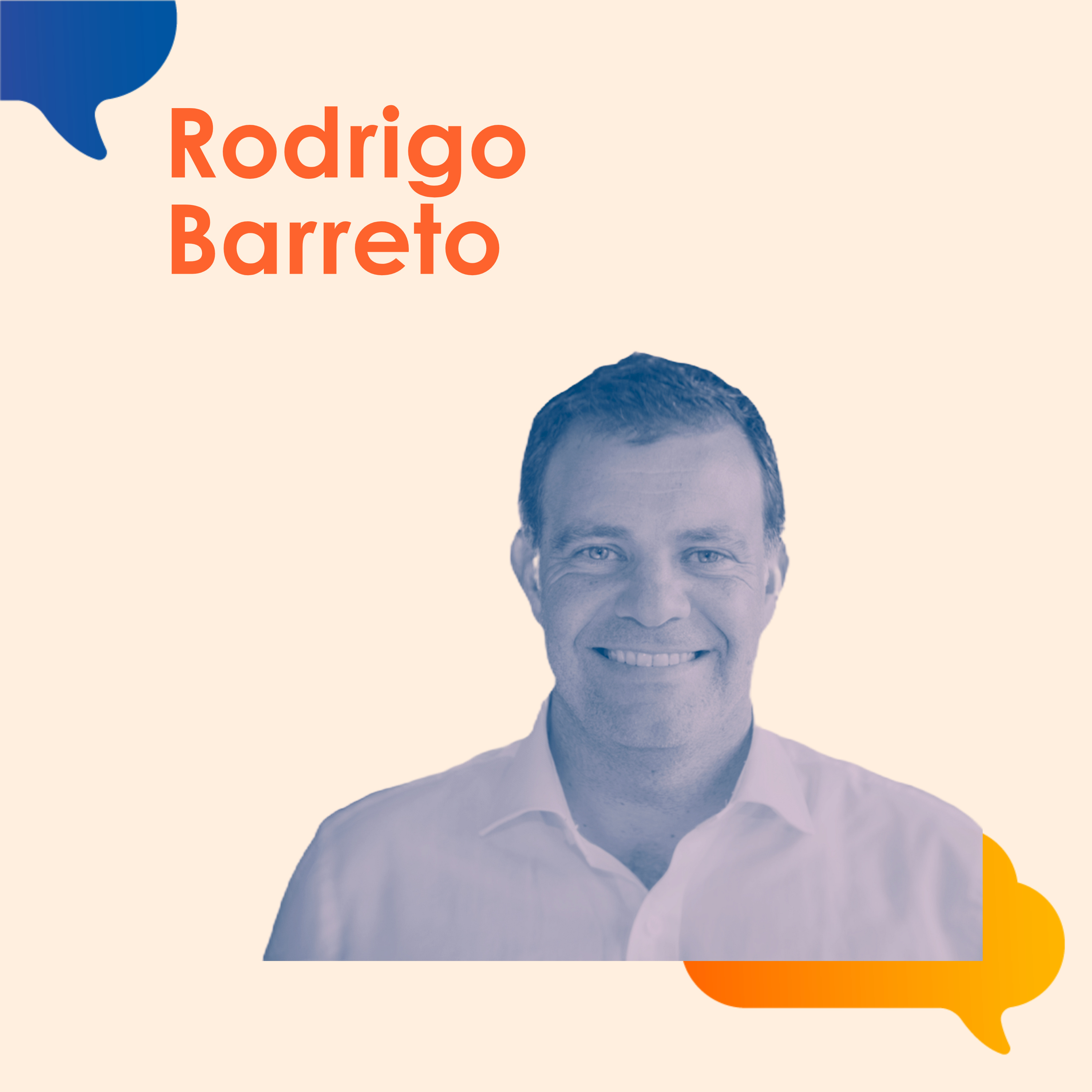
Wisdom, Courage, Justice, Temperance - Four Stoic Virtues to Transform Your Daily Life - with Rodrigo Barreto
About This Episode
Stoicism isn’t about detaching from life — it’s about engaging with it more intentionally.
In this episode, leadership coach Rodrigo Barreto unpacks how the ancient philosophy of Stoicism can guide us through the chaos of modern living. We explore how its four core virtues — wisdom, courage, justice, and temperance — work together to form a complete framework for decision-making, leadership, and resilience.
When practiced together, these principles help us see clearly, act bravely, treat others fairly, and stay composed — even when life tests us most.
If you’ve ever wondered how to stay calm, fair, and focused when everything feels uncertain, this conversation is your modern guide to timeless Stoic balance.
About Rodrigo Barreto
Rodrigo Barreto is a leadership facilitator, executive coach, and stoicism advocate with over 30 years of experience across FMCG, energy, and consulting. From his engineering roots in Rio to working with global organizations, he helps leaders navigate modern challenges using ancient philosophy. As founder of All About the E and T.E.A.M Director at MyBigSky, Rodrigo brings energy and expertise to help individuals and teams find more joy, flow, and fulfillment in their work and lives.
You can connect with Rodrigo on LinkedIn and allaboutthee.com.
Mind Blend is all about real experiences and meaningful conversations—through sharing these insights, I hope to inspire and empower you as you navigate your unique journey.
I’d also love to hear from you! What resonated with you today? What topics or guests should we feature next? Let’s keep the conversation going—connect with me on LinkedIn @ karenkchong and @Mind-Blend
Follow Mind Blend to get notified when new episodes are released!
Until next time, stay curious, keep exploring, and let’s continue to blend our minds and discover what’s possible.
0:01 We talk a lot about superpowers these days, to a point where it might just have become another buzzword. In this episode, I mind blend with leadership coach Rodrigo Barreto to explore the four Stoic virtues, Wisdom, Courage, Justice, and Temperance. When practiced together, these might just be the modern day formula for the superpower for us to live and lead better. Turns out you don't have to be born with them. You just have to start asking yourself the right questions. Welcome to the show Mind Blend.
0:35 I'm your host, Karen Chong, and I'll be diving into the minds of incredible people, each an expert in their very own way. Together, we'll uncover insights and share ideas so you can be inspired and empowered to navigate your own unique journey in life. Ready to get curious and discover what's possible? Let's blend.
1:00 My guest today, Rodrigo Barreto has built a career helping leaders and teams adapt, grow and thrive. He has over 30 years of experience across industries from FMCG to energy and he brings practical know how and wisdom into his work. Hi Rodrigo, welcome to Mind Blend. Hello, Karen. Hello. Hello. Very nice to be here with you. Well, thank you for being here. So before we started the recording, Rodrigo and I were chatting in the green room and we were talking about just some of the upcoming work that he's doing around Leadership Workshop.
1:37 Now tell us a little bit more about your work in this field, how you got into it, how you got to where you are today. Yeah, Karen, thank you. I grew up in Rio, always wanted to be an actor or being the arts in the performing arts arena. And the Brazilian, the Brazilian system is not as developed as other countries where the UK now like you, and you meet people who are Mckisey consultants and you ask what have you done for university? Modern languages and Latin. I'm thinking how did you move from modern languages to do Mckisey work?
2:16 So it's not what you do that matters on the job you get afterwards. In Brazil, that's nothing. So I had to choose early on a career in practical in the Brazilian society and I chose engineering, so. Billion engineering. I'm an engineer. I degree six years of my life engineering and I'm taking that as a gift from the past versus I wasted my time. It was a gift, but I since I graduated when I was 20, one, so in search for where I am now, which is working with people, working with leaders, talking about the human side of things.
2:56 And I've been doing, I've been a consultant now for almost 20 years, the last four and half as a freelancer. So working independently with multiple associations and helping leaders still from big multinationals, big companies to be more joyful, more in the flow and as a consequence be high, more high performers. Then, Karen, I also from a personal side, trying to kind of discover myself more and more. I came across probably three years ago Stoicism not heard about before, 3 1/2 years ago actually.
3:32 Let me ask you this question to you, Karen, the word stoicism comes to your mind. What is, what comes to what? What associations you have with the word Stoicism? The philosophy of Stoicism? So it's funny because I also haven't come across Stoicism until fairly recently, I'd say within this year, and because I know the word stoic, I thought it meant like, it's more observing. Don't just jump to conclusion, but look at your opponent and listen instead of jumping to just saying something. So that's what it means to me, but I obviously haven't dealt deep into it.
4:14 Nice. Interesting. Yeah. I ask people and there's all sorts of associations. Some of them, like you just said, your, your version. There's some that think you have to be passive, emotionless, almost like a picture of a cow in the field. It's raining, it's miserable, it's cold, and the cow is just there thinking, what can I do? I just have to bear with this miserable weather. And what I discovered personally, and I'm applying this to leadership, which is your main question at the beginning, was that storycism is way more than that and it's nothing but being.
4:51 It's not about being kind of calm and doing nothing. It's actually a very active philosophy. Tell us more. To try to kind of summarize this kind of big body of work, ancient 2000 years old. So Stoicism started in with Zeno, who was a philosopher and was in was a was a merchant that was in a storm in his in his ship sunk. And he showed up in the shores of Athens as a banker with nothing but himself, trying to find the answer of how one can live a virtuous life, a virtual life, a virtuous. And he came across the writings from Socrates, the Greek philosopher who, contrary to the noble society, who thought that those virtues were only a gift or a privilege from the rich and from the noble.
5:50 So I think this is human. Everyone can have those virtues. You can be a bit on air, You can be a king, you can be a beggar or a homeless or you and I. And so that's kind of how I started and Zeno fell in love with this idea. And in Athens, I know you've been in Athens because I've been there with you, Karen, the Acropoli. And at the bottom, the Acropoli area, there is this, that, that port Portugal, the Agora. And that that's that's where Stoisi is most found because the word store means porch, painted porch, porch, that place in the agora in the area where the school of Stoicism because of the store.
6:35 The Portugal started 2000 years ago. And people like Seneca, the Emperor from Rome, Marcus Aurelius, Zeno and many others, including more fresh actual people like JK Rowling and Bill Clinton and many other current Schwarzenegger. And I'm throwing some names, but as a lot of people who are Stoics at the moment and follow Stoicism. So that's kind of this story and how what created them and started. And I would try to summarize what is it all about? I think there are two big learnings on Stoicism. First one is that you have to focus on you can what it can control.
7:19 Yeah. They call locus of control the locus of control, and it's not new, just very hard to implement, which is to be spending your energy, your resources, your worries, your ambitions, your happiness on the things you can control and ignoring the ignoring things you cannot control. It's going to rain tomorrow or not. So I can buy an umbrella I can protect from the. Rain. Changing the rain tomorrow or the weather is impossible. In fact Eunice or if the COVID is going to come, nothing can do about it.
7:52 There's nothing to do up with to controlling the events. I can from my reaction to the event, but not the event. It's. Big learning, not new. You probably heard this before. Focus on the things you can control. For me, I think the the new part is then with the remaining, which is what it can control. There are 4 virtues that guides the philosopher Stoicism on easy can control, which is the places where you can do something about, you can react, you can behave in a way that's different. And the four virtues are not in a priority.
8:29 It's not 1234. There are 4 equal powerful and important virtues and they work together as super powers. So you don't have 1 and I will I will show an example of what if you just do 1 without the others. It's not the same effect, the same effect. They have to work as superpowers. So one of them is wisdom. Wisdom. Wisdom, and that is not to be the Buddha in the mountain, the wise men wisdom of day-to-day is is is is being wise. Being wise, meaning knowing yourself, knowing your teams, knowing your emotions, knowing what do you care about knowing your values.
9:13 When you read the book, don't skim the book or enough. So don't say yeah, I understand AI. No AI really you really know it. No, you don't know really You just you just grab your as you think you know. So leave a deep life. I guess that's the main message on. Yeah, I was just going to ask like because when you said wisdom, I was thinking ask anyone on the street, like what wisdom do they have? Probably don't know how to answer. And so it's like, just like you said, going deep in things, go deep into yourself, go deep into like relationships, go deep into subjects.
9:53 Is that basically what Rism is? Yes. And I think because can be very abstract, I I like this shortcut that I use, which is to think whenever you face a situation that is difficult or not or any situation that you want to do something about, you might say, what is the wisest thing I can do now? I got a feedback from a client workshop that we've done and the client wasn't happy just got this message via e-mail from this client. What is the wisest thing to do at this moment? Is it replying upsets? No.
10:29 Is it not replying? No. Is it ignoring? No, Is it replying defensively? No. So even if you just want to be the wisest next move, that is already wisdom is not like, yes, I am. I am ITA Harvard profess. That's not the wisdom you're talking about. He's just thought to say what is the wisest thing I can do to myself? So instead of being feeling blaming myself, is it wise to blame myself? That was my mistake because the workshop is in the world. That's not wise. What is it? Why is well, why? It would be to understand more than the client why the workshop.
11:06 I would ask my colleagues what they felt I would compare with similar workshops in the past. I would understand what is going on. That person, I would think is that person's feedback or the boss's boss's boss who gave the feedback to the person who is now backlash on. Yeah. As opposed to just reacting. OK. Makes sense? Karen Yes, yes. And also like we associate wisdom with someone who's old, but from your explanation it's doesn't have to be the case. Doesn't have to be the case. And sometimes a child wonder, you know, you know what I'm talking about in the line of business you work, Karen, wonder possibilities.
11:45 Your child's full of amazing wisdom. Yeah, yeah. Wonder mindset. Yeah, yeah. That's why really. So that's the what wisdom is all about. And, and, and given that, if there's one area of wisdom that I would like your listeners or whoever has listened to this podcast to think about is knowing yourself. So let me ask you one question, Karen, from zero to 100%. How much do you think you know yourself?
12:13 Zero to 100%. I would say 100% actually. Wonderful. Yeah, 'cause I could predict like there are left brain, right brain for from a professional point of view, I'm very left brain given what I do, personal life, I operate left brain, but I let my right brain make decisions and then I can almost predict how I'm going to react to certain things. And then, as always, it's like my left brain coming into control, giving the reasons why you should or shouldn't do that. But like the the right brain, it's really what's driving my intentions, my actions.
13:00 That's amazing, Karen. So I I wouldn't say 100%. Very pleased to hear that because a lot of people respond 858090, which is understandable. There is an argument to be said that you're never going to reach 100% because then you're done yourself discovering it with to learn. But aiming for 100% or close to 100% is the ideal. And it seems that you are on that you are there. But then I asked the follow up question, oh, 85%, great. How much you wish you knew yourself and not a lot of people don't say 100 percent 97 98.
13:37 Why then, I asked, why not 100? 100 Classical answer I want to leave some surprises and I remember when my leadership professor, my MBA in the US asked this question and and people responded the same thing. Oh, leave some surprises, he said. Can I tell you something? Life is already full of surprises. I really hope this surprise is not you. Yeah, yeah, yeah, very. Powerful, I think as a as a as a lasting message, knowing yourself as much as you can is a gift. And if you are there, Karen, I would encourage then you to move to beyond yourself to now think about how much do you know your team, how much your clients?
14:19 How much do you know your country? How much do you know your family? Because the more aware starting with self and then beyond you are you be a wiser person because you know OK. This is why this person said to me like this. That's why Mary always comes in the morning grumpy. That's why Johnny always trying to help and kind of gets overwhelmed because that's I, that's nature. That's I understand this person. You become one of what ties with the world, with people around you, and you understand you are much more aware life and the universe versus being self-centered and not even aware.
14:56 Of that's when, yeah, being aware of your surrounding and the people is it's more and more important as I discovered. Like I always thought, I think a lot about people. I'm pretty high on empathy, but it's not so much just being empathetic is trying to understand where they're coming from. Like given what I know of them, how they're going to react to certain things because it helps with everything. Team client especially. And Karen, did you do anything? Was this 100% number of self-awareness something you've consciously worked on?
15:35 Is it just because you, how would you explain? A lot of people are not there. How do you explain? How did you get? How did you get there? I well, obvious, like obviously I don't wake up every day thinking I know myself 100%, but I think it's because I did a lot of self discovery earlier on. And what I meant by that was whenever I feel like I'm just in the same spot, like I am not very content. I have to say. Like my mom has told me that like because I when I was younger, I was never happy with where I was.
16:11 And my mom has mentioned that like you, you should be content. But I interpreted it as just being happy where you are and like don't see other directions. So I interpreted it as that. I don't think it meant that though. Like being content is like being happy where you are instead of just trying to run away. So I think I did a lot of self discovery when I feel like I'm just in the same place I hope for. What more can I do? So in the process of finding, what more can I do? Finding what fulfills me that helped me with like I chipped away at the self discovery and then I talked to myself.
16:54 Like I think a lot. So listeners, I'm not crazy, but I do talk to myself a lot in my head. So maybe that's why I have a lot of conversations with myself. That's good. That's good if you love yourself. And I you touched on another very important point on the, on the, on the wisdom, which is the inner voice. Let's get into that. The the roommate who is there all the time. And the idea is that our brains are very powerful, but they are not made to make us happy. The brain is wired. Make us survive.
17:30 So the voice suddenly is talking all the time. And for most people, it's not a good, it's not a good narrative. It's not like, yes, Karen, you're great. Here you go. One more session with this big client, the mega events, and you're going to do amazing because you are amazing. He's like, I check everything. I must be concerned about the timing. I hope I'm well. I didn't sleep well last night. The voice is there talking all the time. Which brings us to the next virtue, because I think I want to connect back to your point about your mom's advice.
18:05 Moms are always very often have good advices, but the they've. Seen more they've. Seen more, they also have more biases. They also have the sometimes an older mindset which brings to the next virtue which the Stoics called temperance. Which people you know, you and I. I'm not an English native speaker. There's not a maybe obvious word, but another way to look at temperance is kind of moderation and another virtue. The other version is, is thinking about moderation, moderation in habits, moderation in the thing, the decisions you make.
18:41 Going back to our example, we've got a feedback from a client. The event is not well, wise person is going to try to understand more what will be moderate or a measured thing to do. Is it calling the person now just after the workshop? Is it scheduling a follow up calmly and then preparing yourself? Is it involving other people? So how do I react in a moderate way? Am I going to set them on a complain or I'm going to be happy? Well, there's a balance. So your comment about your mom is a very interesting one because one can say if I'm content, there's nothing else to search for.
19:16 I'm happy in the present, so why think about the future? Why try to understand more? Why read more? Why have a deeper life? Why to understand? Why try to understand the awareness of my team, my organization, of my community? I'm just happy as is. Well, what a moderate person would do. Would you become a discoverer? And all you do is asking people and talking to people and do nothing in the present? No. Is it to become 100% the present? Ignore the surroundings in the future. And OK, I there's no.
19:47 Answer of what mother is, but in every aspect of life, I'm going to throw another example. I remember when I was trying to I was thinking of going freelancer and independent. Is the wise and mother thing to do to say, you know, I'm fed up of big companies. I don't like this environment. It's not for me. Let me let me quit everything. I want to tell my boss what I think. And then become unemployed and find the job or to stop planning the next step to start thinking about, OK, let me test the waters.
20:16 Maybe let's take, I'm going to take some days off to think. I'm not going to quit my job yet. I'm not going to sell everything, remortgage my house. But that's moderate. But you know, each person has their own compass. But the idea is to be someone with moderation. Do I I want to lose weight? Do you just stop eating and cut alcohol, cut all sugar, cut all sugar, cut all carb and 25 kills in four weeks. Is that moderate? Probably not. Like I'm sure all of us know that doesn't work. The faster you lose it, the faster you get.
20:55 It I am not fit, I haven't worked out for six months, am I going to sign up for an Iron Man? That's a bit too much is it? So maybe you start doing 5 days, maybe do a sprints right out from in eight months. Maybe you hire a coach and go slowly. So that's about the moderation part. Yeah, yeah, like I encourage my friends around me, like I stress the importance of living the moment, but it doesn't mean spending every dime you have today. So, but definitely enjoy the present, prioritize the present.
21:27 Use history to guide you because like you may encounter similar situations and if you act a certain way in the past where you're happy with what you did, use that to guide you. And then for future, it's like a goal post or something that kind of tells you what direction you want to go. But live in the moment. But I I find it hard for people to, I think, oh, live in the moment, forget my job, just like pick up my bags and go somewhere like travel for like 10 years or something. No, that's somewhat I mean, but I find it hard for to explain to people how living in the moment really is.
22:06 And you said it perfectly moderate. Yeah, which again is. Very, very subjective. What moderate means and means different people for different. It means different things to different people. But I guess if you if you again, if you use it as a rhetorical question to yourself and think, what if someone with balance would do I think I need to lose weight or I think I need to get thinner or I think I need to be a bit more outspoken or my life needs to be more adventurous. You're going to quit everything, sell your house and go to a safari for 10 years.
22:36 You're going to live in a boat and I don't know, everything you've built. Maybe, but maybe not. Maybe you don't need that radical, a bit radical for me. I'm, I'm talking with my lenses, Karen. And part of being the moderation virtue, the temperance, part of that is also discipline, self-discipline, moderation. So. There are many books about that in Stoicism, and one of the books talks about an example that you and I probably the world can relate to, which was the Queen, the late Queen Elizabeth, Prince Philip.
23:06 Her husband died during COVID and because the nation was told to use masks in isolation, Picture a very unique picture of the queen at the funeral at the church sitting herself away in black with mask and she's the queen. She could have the Oxford doctors doing COVID tests to make sure 100 percent, 3,000,000% sure that everyone of her in the family are safe and not contagious. But yet a discipline person thinks that's what I asked my country to do. That's what I'm going to do because that's the right thing to do and that's discipline.
23:45 The story that he was trained to be a royal and and do her duties. There's a story of that. She went to an event in the personal organizing. The event was like talking to the her, her assistant saying I'm a bit concerned about the Queen because we're going to be standing for a long time. As I said, she's a professional and she's trained for it. Be concerned about you. She will stand for 8 hours, no complaint, no toilet. She's trained for that is. There any anyone? And I, I, I may put you on spot and you might not have anyone in your mind, Karen, but you think of a disciplined person, might be a family member, might be your mom or someone external.
24:24 Is there anyone that comes to mind as an, as a, I'm giving you time here to think. And if you don't have it, you might not have it on the spot. Who can comes to your mind and think of discipline. A discipline person I tend. To think of those fitness trainers, like there are a few that I follow their program, but as I'm saying this, I we only see their fitness aspect, like the fitness side of them. But yeah, like fitness coaches because everyone wants to just sit back and watch TV and not do anything and eat some junk food.
25:05 Maybe not all, but like the the indulgence. Nobody specific I can think of. Yeah, I think fitness sportsmen. Very good ideas, very good examples of discipline. And that that remind me of a quote that I love about discipline, which is easy choices, hard life. Hard choices? Yeah, easy life. When I have the. Easy choices. I want to eat the ice cream because I want the ice cream. I want to not go to the gym and watch Netflix and it's and have a wine. That's the easy choice. You might hard life in the future with diabetes and problems and weights if you.
25:42 Do the hard. Choices, money, saving, working hard, going to the gym. Do what I think is right for my body and my soul. If you do that, well down the line, you're going to have easy life in your life. So again, Second Virtue. So and and hopefully you can start seeing the links, Karen, because how do you know what is moderate and self-discipline? Well, you have to have the wisdom to know what a wise person would do the situation. Yeah, so. I start seeing. The connection between wisdom and temperance.
26:20 Yeah, like. This, this just came to mind 'cause this happens all the time. It not so much to me anymore. It used to is knowing when you should stop eating. If I eat one more of this, I'm going to be so sick afterwards. Then don't. Yeah, So that example. Shows that you have to have the knowledge either of these experiences or because you read books and doctors you follow and trainers you follow, that the portion is to be X, not X + X. And the temperance to be able. To do that, because you know the why, the wisdom is there, you need the temperance to moderate.
26:57 Your turn off what happens? Indulge the next The next virtue, Karen, is justice, which is not the court of law, tribunal law. It's about fairness. It's about kindness. It's about doing the right thing even when no one is looking and again, I love this rhetorical questions to think about that virtue like all the others, which is what is the right thing to do here? I'm in a meeting I. Can see someone. Making a semi inappropriate joke with someone else in a meeting. You know, it's psychology. There's a terminology that the microaggression, maybe the microaggression is not obvious, but it's a bit of a little joke there.
27:45 Maybe we're touching on, on a, on a, on a hot button and you think that's not cool. What is the right thing to do here? The right thing to do is again, depends again, you have the wisdom to think I might talk to the CEO, to my boss or the colleague. Is it a meeting on a bar, on a meeting setting or in a church? Have the temperance. Do I call the person in front of everyone or half an hour later, do I call for a go for a coffee afterwards? So you need the temperance, but justice means what is the right thing to do and kindness just and kind.
28:20 And I think sometimes, at least for me, Karen, I keep thinking about that virtue most often to other people. But a bigger heart lately is like is as much to other people as to yourself. How can I be kind to myself? I failed, I messed up, I did some, I didn't do a good job on that session, on that workshop and with that client, with that discussion with my wife. I'm human. What is the kindest thing I could do to me, to her, to my boss? What happens to my interaction? What is the kindest thing I could do?
28:51 Apologize to be kind to myself, to now stop work and go for a walk Again, there's no one answer for those things. But what is the kindest thing I could do now? And there's no answer. But I'm sure when you are in a stress situation and something goes wrong and you think, what should I do here? That's what philosophy comes for. You can say what is the kindest thing you should do now to me and the person kind of humiliated me in a meeting. What is the kindest thing I could do? Well, I could my passion and assume the person not doing because of me is something's going on in her life, his life.
29:29 What is the kindest thing that I could do is to kind of share my feelings person what is the kind of thing kindest thing I could do to me? Do not take it seriously to believe in my. That makes sense. Karen, how does that sound to you? It does. But I think it's so I'm sure many people will not will struggle. Like I don't know what the right thing to do is right now. Like how do how can they start training themselves so they, they will be able to like they can get closer to being able to figure out what's the right thing to do like at this moment, because a lot of the times like you're reacting right.
30:08 I love what it just said because. It's going to help our discussion. So your question was how one knows what is the right thing to do in this situation, right? Then the next question is what, what, what a wise person would do not knowing the answer. If you are a wise person, you don't know what is the right thing to do. What could you do as a wise person? Find out more. More Yeah, a coach at. Your mom? Yeah, go for a colleague. Say, I'm a bit confused here. I don't know what is the kind of thing I could do?
30:42 What do you think? You can ask TBT and see what comes up there. You can read a book that you love about meditations. You can talk to universe, you can go for a walk. But again, if the answer of what is the kind of thing I could do now, you don't know, think about what the wise person would do well as as you responded, you find you find knowledge. I need to spend next days trying to find what is the kind of thing that could do this situation, or the next two hours, next two minutes, the next half an hour.
31:11 Yeah, and that ties in, ties back into how a person can grow because you don't know the answer to everything, but in the process of finding the answer, you'll build your knowledge. Absolutely. And. Then that's. How someone grow you can say how. You build the knowledge well. A wise person would ask people with knowledge to see how do I get more knowledge about XY and ZA person with temperance is not going to say yes I need more knowledge. I'm going to read three books per day and after 2 webinars have 16 letters.
31:45 And that's just a bit. And studying even a library that's not moderate that. Yeah, yeah. Yeah, and the final. Virtue, yes. Courage, which is not final. I at the time I talk about stoicism, they come in different orders. There's no one comes first, OK, You have to have the courage to find wisdom. You have to have the courage to say, OK, the right thing to do is go to the gym. I need the courage to kind of sign up for it. The right thing to do in this situation where a microaggression for the previous comments happened in a meeting, I know what is the wise thing to do.
32:20 I know a mother person should do this, not now, but afterwards on a coffee. I know what is the kindest thing I could do, but I get the courage to say I'm going to actually do it. Or the wise plan that never happened. So you have to have the courage. You said, Karen, you know yourself 100%. You might think, oh, this is job opportunity now. There's a great salary. It's not what I love, but it's good. It's actually going to detract from my core. It's not going to add to my life. And it's actually in a company that hasn't, doesn't have a good ethos with a guy or a girl that I don't even like so much.
32:56 But it's good money.
32:59 My internal compass thinks shouldn't be doing this. So you have to have the courage to say. No, sorry. How about the money? I might have less money this year. That requires courage. How would you define courage? Like is it doing something when you don't feel comfortable? Or how would you define courage? Karen, I'm going to be wise here and answer and kind to myself. I don't know the answer. I have no idea how to define courage. Maybe we can create together. I like your starting point, but probably to make the decision and do have a behavior, do something it is not comfortable.
33:42 I would say probably that requires courage. Courage might be and again, I don't have a a definition, but it might be something around doing something when it's uncomfortable. You know, if you I don't know how much you know about the work from Brenna Brown, who talks a lot. She has this book there to lead. She talks about her ability and talk about courage. And she has a quote that. Says you can choose comfort or courage not at the same time you cannot have you cannot have comfort and not have to do it and and and comfort is the the require courage so.
34:24 In other words, to. Be courageous means you have to not be comfortable to the different. Something better, something more alike. Values stop doing something. You have to have the other to leave your job and find another job. You have to have the other to lean in a discussion that is extremely uncomfortable, that required. You have to be comfortable to push yourself to learn more. You're uncomfortable to stop eating the second ice cream and tomorrow do fasting, etcetera. So this completely relates to what you said earlier about it's not just one of the virtual they all have to work together because doing something that's uncomfortable could be.
35:07 That's not the right thing to. Do yeah, you know, you could say. In I want to double my revenue in this business, I'm the CEOI want to double the revenue. I want you all to work very hard. I not work. And by the way, that's my, my vision. So I, I want to, I want to know from you employees, if you are on the bus or out of the bus, there's only two options. Be on that journey with me or out. Oh, that's courageous. You're putting everyone on the on the spot. Is that wise? Is that a wise thing to the world?
35:40 You're going to get the best out of people? Probably not. Is moderate to say double, maybe 30%. Is it moderate to say everyone is to work double time? Or is more moderate to work a bit more or choose a day of week that you work more or work or work more for two months, but then I have some time off in addition, in lieu, is it kind to people? And it's your dream and your greediness to grow double digits in the expense of all your employees who perhaps don't care about growing double digits. So again, they need to work as superpowers together.
36:17 They have to work together.
36:20 You argue some of the leaders in. The Western world, places we know and are very controversial, very courageous. Is that why? Is that kind? Is that fair? Is that, is that balanced? Is that moderation? No. And you see the result? Yeah. Yeah, it's it's worse. Very courageous. Yes, to start a war. To throw a bomb somewhere else. That's courage. Is that, I mean, is that, is that the right thing to do? Is that, is that wise for the society, for the world? Oh, Karen, that's that's for me why it's fascinating.
36:52 And I think the I want to maybe share two more things that isn't, you know, my mind or my mind. Yeah. Yeah. 1. Is it? A lot of people might listen to this podcast and think, yeah, it's a nice philosophy. Yes you can. Treat it as a philosophy for life. But I also dare anyone to come with an example from business life and corporate life and career life. That cannot be. You cannot apply the the four virtues. Examples about the workshop. Feedback from a client, I mean, so it could be your company, could be your career, you could be your marriage, you could be yourself, you could be your professional ambitions, you could be your 5K you want to run, could be be more healthy so you can apply.
37:37 Those are virtues. Those are things that are not, he's not a leadership model. He's not a leadership model. The six keys, the, the, the 8 levels. It's a philosophy that guides you on everything you do, including work, including the including your personal life, etcetera. So that's the first thing. Don't take the word philosophy and Stoicism as yes, it's like something unattainable. I work in a hen, I work in a retail, I work for McDonald's. It's a retail business. It's hardcore. I work for an investment banking.
38:09 It's knife on the mouth. It's like a hard work 24/7. Yes, I can prove to you that if you apply Stoicism to your banking, investment banking life, you could be a better person, a better leader and a happier, more joyful human being. And the second thing to say is that is that doesn't doesn't finish. I don't think you've said yes for the last five years. I think acting story says I'm I'm done. I'm graduated. I achieve enlightenment I'm. A spoic you never it's a daily. That's a very good point. It's nice.
38:45 It's a journal that. This is a it's a philosophy for life. Lots of people choose Buddhism, some people choose whatever else. Gardening or following the universe or quantum physics, all that all this is one way to look at life and navigate your life until you die or even beyond death. Who knows what happens beyond death, But even that thought about beyond death could be applied with Stoicism, yeah. Philosophy so I. I love it, Karen. I love it. And I encourage everyone to take a look if you are. Yeah.
39:20 I'm I'm sure there's so many books. Well, it's been around for 2000 years, so I'm sure there's countless number of books around Stoicism. But I think it's really useful to kind of cast a new lens on Cyrusism, especially in our world today, because it's we're more and more connected. So we interact with people who we wouldn't be interacting with like say 30 years ago. And it's, it's important for us to live life. Just thinking more. Holistically, I think holistically about ourselves, about the world, about the impact we have on the world and the others, the ones.
40:02 Near us anyone who we interact with so I'm really glad that we have this conversation today yeah that makes. This even more important to because if you could argue if you were say, well, in 40 years ago, if you were in Okinawa or in a car, yeah, in Greece, one of the blue zones, 2 of the blue zones and there are many few others maybe don't need spaces because with from the plants, from the garden and organic things, you get relaxed, people help with children, community, you are calm, you are in the sea, in the earth.
40:37 You don't have so many stressors from the outside or maybe need any philosophy. You're just enjoying the day-to-day or the present. By definition. I just have a a new kitten. Well, a kitten is new because the kitten, but new to me as well, Yeah. Behaving. Metro, there's no, I'm going to I'm going to stress about my next meal. But you I I think the point you made, Karen, that we are in this crazy life full of a stimulus from the outside, full of mental diets that are not healthy. Yeah. That. That there's a toll to pay, and I think that's why I'm so happy to be following Stoicism, helping anyone who wants to be on that journey as well.
41:24 Because I think you could. Be just the right antidote for all this business is a way is a life that helps you to kind of step back and think OK, it's a big problem happening or I got I got laid off or my my money is not my mortgage. OK, what is what is the wise thing to do is that me sell everything? No, is it I'm going to stop my job and what what is the wise person would do? What is the kindest thing to do to myself and think about myself or my wife and my family or my kids? What is the mother thing I could do to start earning more money or doing that more of that or less of that, etcetera.
41:58 So it's I think it's the right moment. Yeah, yes. Especially now. All right, let's do something different. I'd like to finish my episodes with the rapid fire questions. All right, right. What's your morning routine like? Try. To free up the morning and don't look at the emails or phone for the first half an hour and almost like wind a day in the morning wind the morning. There's a quote that says wind the morning wind the day. However, Karen, when that not always works. But that's my attempt. That's my.
42:36 Yeah, at least you try. I try first half an hour. Clean. Otherwise it's swallowed by the thinking, the thoughts, the upcoming. And then you start the day with the wrong foods already. Yeah, yeah, you. Get sucked into refining something and then you didn't get to do the other things and I follow. If you, your listeners or you would like to acquire, there is a very famous guy in the US who writes about storycism and makes it very digestible, very day-to-day, called Ryan Holiday. Has many books, all greats and yet one with a Daily Stoic.
43:11 Oh, OK. For every single day of the. Year so part of this half an hour morning routine is to read the Daily Stoic and make some quotes or annotations and and there's a little bit of a diary of what does it mean to me that daily for the day and every single day of the year there's a passage from Seneca from Marcus Aurelius and his interpretation with that quote that's. Nice. That's temperate. Just a little bit of day, All right? Do you have a favorite Stoic quote that leaders should remember? Oh my God.
43:45 Me, can I think a little bit about that, Karen, I need to think about it. I don't have one of the this one. Sure. No problem. What is the biggest misconception about Stoicism that you would love to just make it disappear? That is something from the. Best and philosophers from Greece in a different life than mine would follow. Nice to read when I have time, but it's not applicable to me. Yeah, listeners. Let's throw that out the window.
44:20 Who is 1 modern day leader that you think embodies stoic principles? Probably Ryan Holiday. Ryan Holiday is a very famous guy. He used to work for American Apparel, I think American Apparel in the US, He was a marketeer, corporate person, left it and now created a very successful business with podcasts, with books. So he's leading a movement. It doesn't lead people, I think, but he leads a movement doing podcasts and he embodies well. He actually makes fun. He said in my household, my wife's, my wife keeps telling me, one of us right about storicism.
44:58 The other one actually practices even for him who is an expert on the topic of practice. But I think he's a leader that embodies stoicism, you know, in a big way. That's great. When you need to reset, like I say that the day is in total chaos. You need to reset. You really need to slow down and just start over. What do you? Do I tried to get in touch with my values and the things that are important to me doesn't always work, not a work. I don't always do that trick or that heck, but when I do it, it's very powerful to to kind of just step back and say, OK, look, look at the perspective to things.
45:41 Think about your soul. You're a kind person. You only can do what you can do in situations. And my values care and I, you know, the the three values leave love and learn. So I think in my living in my living life, is it human? What is going on to me? Yes. Am I loving myself and I'm loving what's happening as if it was done for me as opposed to to me and finally learn. I work in learning for the last almost 20 years. Am I learning from the situation? I'm stressed? It is I reacted very badly. I'm having micro panic attacks internally.
46:20 I I'm out of control, I'm overwhelmed. Am I learning from this is a what, how? What can I learn from this? So is this kind of micro step back? It doesn't take two hours. I don't have to go for a walk necessarily because maybe there's no walking around or and I try to avoid the traps, the escapes. I love red wine, love a beer. I love exercising can always be a a way out. Sometimes the way out is not the best, the best ways the way through, which is kind of, you know. Yeah, a very famous historic.
46:56 Quote for your second question, which is what gets in the way becomes the way from Marcus Aurelius. The obstacle becomes the way, so he gets what gets in the way becomes the way. The way through, as opposed to the way around. So like finding how you can overcome that paves your path? Yeah, not. Escaping from the facing the fear face problem, face the situation, because what they say is well, that people with courage you. Certainly. Don't have fear. They have exactly the same fears you and I have, but they are much more intimate to their fear and they are better able gain courage to put up with a discomfort and say, OK, this is difficult or a a medical diagnosis or a child at work or a pain that is kind of for a loss.
47:45 Nobody likes it. And and off I grew up in a family in in Brazil where I think it's a Brazilian culture as well. To be positive, to try to, yeah, life is good today. Tomorrow is going to be better than today, which is very nice because it's very optimistic. But it's an element of it, Yeah, that escapes that. Dealing with the, the, the pain. Dealing with the pain, the fear. Yeah. Yeah, again, moderate like, yeah, the really the biggest take away really is these 4 virtues, wisdom, temperance, courage, justice.
48:19 Like they really have to work together. And thank you so much for having this conversation with me, Rodrigo. It's always good to catch up with you. And really wise words that we have today and caring. Thank you for. Having me and thank you for giving me this aura that you have and. I'll see you. Live now this smile and the trunk will kind of give this kind of vibes to me that I think, oh, sometimes I'm going to use that voice when I'm thinking I'm stressed, even calm, a gentle voice I love. So thank you very much for having me and for being you and doing this great work with the Mind Blend.
49:00 The podcast is wonderful. Thank you.
49:06 Thanks for listening to this. Episode of Mind One. If you enjoy the conversation, don't forget to follow and share it with anyone who needs to hear it. And let's keep the conversation going. Connect with me on LinkedIn or leave me a comment. Until next time, stay curious, keep exploring, and let's continue to blend our minds and discover what's possible.


 Spotify
 Apple Podcasts
 Amazon Music
 Castbox
 YouTube
 Castro
 Goodpods
 Moon FM
 Overcast
 Pocket Casts
 Podbean
 Podcast Addict
 Podcast Republic