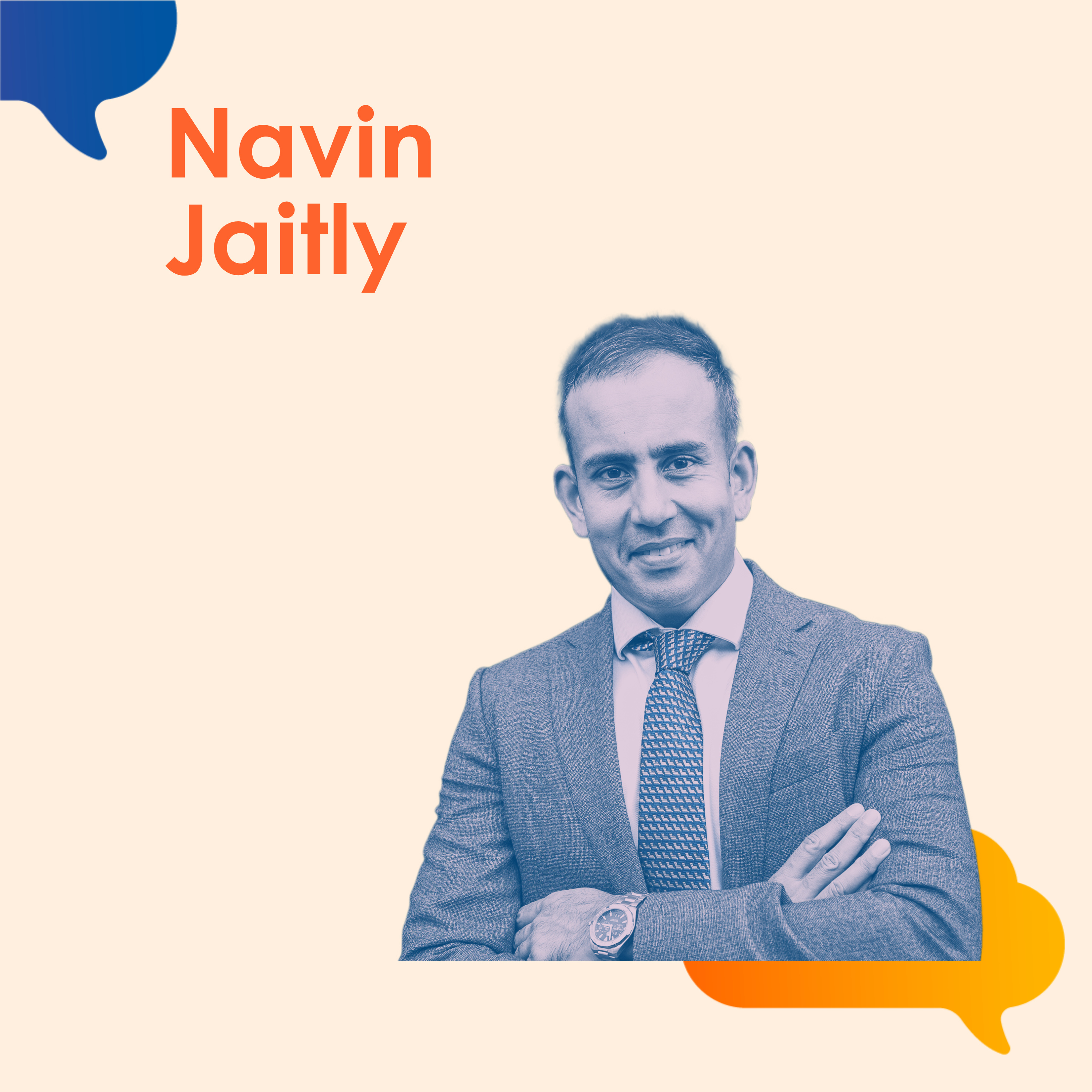
About This Episode
In this conversation, high-performance coach Navin Jaitly breaks down the mindset and techniques behind powerful speaking: easing anxiety, using body language intentionally, communicating with clarity, and tapping into the confidence you already have.
We dig into what really makes someone influential — from vocal delivery to mental framing to how you manage your energy in the moment. We also talk about the hidden cost of not being able to speak confidently and how learning this skill can transform your career, relationships, and everyday interactions.
If you want to speak with more authority, persuade effectively, and feel confident in any room, this episode gives you the mindset + tools to get there.
About Navin Jaitly
Navin is a high-performance coach, award-winning speaker, and bestselling author who transformed his career from struggling salesperson to top performer through mindset training and communication mastery. Today he helps leaders, founders, and sales teams speak with clarity, confidence, and influence — combining proven techniques with deep inner-game coaching.
You can connect with Navin on his website navinjaitlycoaching.com, You can connect with Navin on his website navinjaitlycoaching.com, Instagram Navin.jaitly, LinkedIn navinjaitlysalescoach, and email [email protected].
More details about his workshop on 1 December, Speak to Influence, available here.
Mind Blend is all about real experiences and meaningful conversations—through sharing these insights, I hope to inspire and empower you as you navigate your unique journey.
I’d also love to hear from you! What resonated with you today? What topics or guests should we feature next? Let’s keep the conversation going—connect with me on LinkedIn @ karenkchong and @Mind-Blend. Prefer to connect more directly? mindblendpodcast [@] gmail.com.
Follow Mind Blend to get notified when new episodes are released!
Until next time, stay curious, keep exploring, and let’s continue to blend our minds and discover what’s possible.
0:00 How do you get into the customer's world and how do you generally come from a place of service? Because I think when you do that, you've got a much better chance and people trust you more.
0:12 So here's something that may be really obvious. Speaking is something that we do every day. I'm speaking right now on this podcast. But not everyone speaks the same way. Some people definitely seem to be able to do it easier. They're more powerful, they get their points across in a much more confident and convincing way. Why? So today on Mind Blend, I'm joined by Navin Jaylee, a high performance coach who teaches people how to speak with clarity, confidence and real authority. Welcome to the show Mind Blend.
0:49 I'm your host, Karen Chong, and I'll be diving into the minds of incredible people, each an expert in their very own way. Together, we'll uncover insights and share ideas so you can be inspired and empowered to navigate your own unique journey in life. Ready to get curious and discover what's possible? Let's blend.
1:11 Hi Navin, welcome to Mine Blend. Hey, Karen, Yes, thank you for having me. So as I know and as I've alluded to, you're a confidence coach and award-winning speaker. How did that all start? Yeah, sure, I can do it. I can give you the, I'll give you the quick version of the story. But basically I had a, I've had a career in sales. So I was working in corporate sales, you know, about 20 years ago I started and like most people, I actually struggled at the beginning because sales isn't an easy. Profession.
1:43 And I didn't really have much experience in that. So I started there and I struggled and I basically was going to get like one of the jobs I was working in. I was going to basically get fired because I hadn't really got anything in my pipeline. I hadn't really got any sales on the board. And I remember going to one meeting and in the meeting it went the worst possible. I was meeting ACEO and I was like, this was deal was really needed to keep me on track or to keep me basically to keep me in a job even.
2:12 And it it didn't go well. And he actually, he actually told me the meeting we're not going to be buying from you. And it was the last meeting of the day. And I remember going home that night and thinking, you know, I might just had my resignation notice in tomorrow. Like I'm not really enjoying this sales game and I'm not doing very well in it. And, and something in me just made me go actually, look, if I quit this, you know, I might always be quitting things. And you know, I think I've got some of the attributes needed to be good at this.
2:43 So let me sort it out. And So what I decided to do is I just started to get into personal development at the time. And like I understood, you know, most people, not most people, everybody was saying that if you want to be top in anything, you need to invest in yourself. So I knew my company wasn't going to invest in me because at the time I wasn't really performing or performing to the level they needed me to. So I decided out of my own money to invest in not just a sales coach to help my selling skills, but I knew a lot of it was about the game, the inner game, the mindset.
3:14 So I took out a mindset coach. Again, I'm giving you the shorter version of the story. And within a short period of time, I started doing a lot better. And as a as the months went by, I started getting more and more wins, better results, and eventually I became top of my game. And for the rest of my sales career, I was always in the top few percent of people. So a few years ago, I wanted to start my entrepreneurial journey. It was something I'd always wanted to do. And it was one of those classics During COVID.
3:43 I thought now is the time to do it. Yeah, that's a catalyst. Yeah. It's a catalyst, right? Yeah, Yeah, that time to reflect if you can actually now, now, why not now? And I knew like I had got the skills in sales. I, I really do my stuff there and also what I'd done and I had invested a lot of my own personal money and time in personal development, developing myself. I did a performance coaching, a qualification, which was, you know, a pretty intense 1. So I also became a coach. And then I thought, look, let me combine the two and let me coach and train people in the sales world.
4:19 So, you know, whether it's sales or business development people in companies, that was my original plan. But as I started my entrepreneurial journey, what I realized is most other entrepreneurs, they didn't know how to sell. And that's why a lot of businesses, I mean, the stats in the UK is one in two businesses fail every, some say three years every, some say five years. And I'm a big believer that one of the main reasons for that is they don't know how to sell, right. So they've got a great product or service, they're really good at what they do, but they're not bringing the customers in.
4:49 So basically for the last few years, I've been helping sales and business development teams within companies turn around their sales and also entrepreneurs who want to get better at selling themselves. And I've used that combination of skill set, sales skills, influencing and speaking because speaking is one of the ways that I myself have drummed up a lot of business. I believe speaking is a great platform to get out there and share your message. So if you're very impact driven, which I am also as well, then speaking is great.
5:19 So really what I've been doing is providing the technical skills in sales and speaking to my clients, but also a lot of what I call the inner game of mindset. So I have the tools and techniques of how to actually get people what I call their most zone of genius, their most flow state, where they're most confident. OK. And that combination is what gets results. And I think there's too much out there that just focuses on one or the other. I mean, you got a lot of mindset coaches out there which are fantastic, but I think there is skillet.
5:53 I think there is still skill needed when it comes to influence and sales and speaking. And then you have a lot of people who teach the technical stuff, which is very important, but they don't teach the inner game of mindset. And what we do is what I do is I do both. So that's how a nutshell of how I got into. This. So it's personal experience and then you yourself got some coaching. Do you remember what were the key problem areas when you were not really performing? Yeah, sure. I mean, look, some of it was just actually knowledge in some of the more advanced sales skills because there are, you know, I can explain a few as well.
6:30 There are some technical skills needed when selling and influencing people. OK, now it's ranges from a few things like the types of questions you're asking. I mean, for example, when I wasn't selling so well, I'd go into meetings and I'd talk too much and I'd be talking at customers. I wouldn't be asking those really powerful questions to uncover needs. That's just one example. And then the big thing as well was that that inner game confidence, because when you're not sales is very, it's very ruthless in a way because there's no hiding, right?
7:02 It's a, it's a number. You're either hitting the numbers or not hitting the numbers, and because of that, when you're not hitting numbers, your confidence starts this up. You start doubting yourself. Well, or you start, yeah, you start doubting yourself or you start, you're not in this sort of powerful state you need to be. So when I wasn't selling as well years ago, now I look back at it in particular, my confidence wasn't where it needed to be. And The thing is, you could actually be still quite a confident person.
7:28 I I know a lot of confident people. Like in my general life at the time, I was actually had a decent amount of confidence when I was in social situations. But there's a difference between being like general level of confidence and when you're selling a product and service, either as a professional sales or business development person or running your own business. I think there's confidence level have to be even higher and elevated to really, really become successful or, or when you're speaking on stage, right?
7:53 Like how how many times you, you probably know people and I know people who are really confident when they're out with their friends out in a group situation, stick them on stage and suddenly their confidence stops. It's the same person, different platform, suddenly the inner game changing. So it asked you a question when it wasn't working as well. For me it was a a combination of lacking some technical skills and I'd say that inner game state, confidence, whatever you want to call it. So I know you have a workshop coming up in just less than a week, so I'm not going to ask you everything that you're going to talk about at the workshop, but let's break down the technical skills because I know, like for me personally, nervousness, anxiety is definitely my biggest enemy.
8:37 I feel like I was doing company training and I know the material very well, but my voice was trembling. Thank God it didn't come through in the recording. So I think that might be one of the big area for a lot of people. Yes. Did you mean the anxiety side of things? Mm hmm. Yeah. Yeah, so look, everything obviously different things for different people, different people have reasons why, why they're being anxious. And, and also, you know, depending on the situation. I mean, I've, I've stood in front of hundreds of people and spoke.
9:05 And even though I'm an experienced speaker and, and, and a very confident speaker on stage, I mean, I generally don't get that much anxiety. But sometimes even I still will get a little bit of anxiety if it's a, is a, if it's a, a situation that I really want to go. Well, of course, a little bit of nerves to remember are actually quite good because I know it's a cliche saying, but it really shows you care. If you don't care at all, you're not going to get nerves. So a little bit of nerves and anxiety is actually good.
9:30 I mean, I, I, I like sport and I one of the sports I like watching is boxing. And I always remember that one of the famous boxing trainers custom auto, he said fear make it your friend. Fear. Anxiety goes fear is like a is like a fire. It can keep you warm, right? But if it goes out of control, it will burn you, right. And it's the same with anxiety. So I always say little bits, little bits, fine. But in terms of how to reduce that, like one of the things I talk about when either sales or speaking, right, when you're, you're going to jump on stage, you're going to be on a camera, you're going to be on a whatever it is on LinkedIn, social media, a virtual stage, an in person stage.
10:09 Or you're in a, in a meeting, you're pitching to people, you're pitching for investment or you're in a sales meeting and you're looking to influence someone. All those situations can bring up a little bit of anxiety and understandably so. And so one of the things I always get my clients to do and get people to think about is your deeper why? Your deeper why? OK, yes. Why are you speaking at the moment? What's so important about it? So for example, I'll I'll keep it, I'll keep some examples to myself and make it easier.
10:39 When I'm speaking on stage, I'll always remind myself, why am I speaking about this topic? Why am I speaking about influence and sales and confidence and mindset? And the reason is because I'm passionate about them and they can help people. So when you come from a place of service and helping, you almost make it less about yourself and you make it more about your audience, which naturally reduces your anxiety because then you're not trying to perform, you're trying to. Connect. Yeah, yeah, right.
11:07 Yeah, it's a different energy when you're trying to impress and perform versus when you're trying to connect and help, right? And when you're trying to connect and help people feel that more important or just as importantly, you actually feel less nervous because you're in a different state. So one thing I will say is is always remind yourself and I think anything you do, even in your regular job, right? If you're connecting to a deeper Y, right, that can really help. But some people say, well, I haven't got such a spiritual powerful reason for my why I go, it doesn't have to be.
11:38 It could be you're doing this because you have a family and you want to really provide well for them and you realize this talk or this sale is going to help do that, right? So it doesn't matter what the why is, I think get in that why. The other thing related to that is, again, always remember like what you're doing, how it helps. So when I'm selling my products and services, when I'm speaking on stage and I'm educating my audience and then promoting what I do, I'm doing it from a place of this is going to help them.
12:09 Like the amount of business owners, the amount of people I work with who are like so relieved when they're able to start influencing and selling more, right? It's it's life changing for them sometimes, right? So, and I remember myself 20 years ago when I wasn't selling and then when I did sell, the difference, it was like financially just I was coming to work, enjoying work rather than not enjoying it. You know, you're a happier person. So where I'm going with this is with my coaching services, The reason I can speak with so much conviction and I'm not sort of standing there sitting there thinking, oh, I hope they like me or I hope they don't think I'm being too pushy.
12:44 I'm like, no, I know that what I've got is a value and as long as the other persons need it, then it's my duty to, to tell them about it, to influence them to be in my, my powerful state. And so kind of relate to the first point, but knowing your why and knowing how you're going to help people is really takes the pressure off you and stops getting in your head and makes you come from a place of service. And then the other thing I will say is state management. State management. Yeah, like sports people do it a lot, right?
13:15 So they good look to get themselves into a peak state. So a boxer before they're going to go in the ring, they want to get in their most confident state. A football player before they're going to take a penalty, they want to get in that state of conviction, OK? It's the same when you're speaking or selling, OK? You want to be in a state of as much confidence as possible. So one of the things I always say is like, I remember one of my clients said like, what's the best way to prepare for a meeting or before or prepare for a talk on stage?
13:43 And I said, look, of course practice, know your stuff. If you're going to know about your client, know about your audience, all of that stuff is you have to do, but it's also really important to be in a state of confidence. So what I always get my what we can get people to do before they're going to go on a stage or they're going to go into a meeting is actually literally go through all their wins in their head. Go through what makes them great. Go through their if they're selling a product and service, go through testimonials of like clients who've just really benefited from that, right?
14:15 Write it down or go through in your head definitely before you're going to go. But one of the things I encourage my clients to do is do this on a regular basis, like once every few months. You should write down what's so great about you, what's so great about your product and service. And when you're then actually got tangible evidence, the brain is always looking for evidence. You've got to remind yourself of why you or your product or your service or what you're going to speak about is so great.
14:43 And if you combine that with how is it going to help people and what's your deeper why, that will get rid of 7080% of anxiety. Then adding some other technical skills on top, practicing and things like that, that's going to help with the other 2030%. But I always say like 70 to 80% of of performance of Speaking of influencing of life, even it's in the brain. Yeah, the going through your wins. It's something I do as well. Not necessarily before a meeting because I don't have a lot of speaking rules, but I save little Slack messages.
15:19 Amazing when people praises me. Yeah, because like for what I do, project management, you don't get the credit when a project goes well, you get blamed when it fails. So yeah, that's a really, really good confidence boost. Exactly. So when someone is speaking and the people think, oh, this person is good, what are some of those cues that we are subconsciously responding to? So, yeah, I mean, look, really good question and we respond to a few things, but one of the big things is, and I think people don't realize it, you're responding to someone's energy and energy is a bit of an intangible.
15:56 It's an aura. But but we do, you know, forget about going to the science of it, right? There's a lot of work now about reading of energy and how people read each other's energy. Now, I really believe that you are going to get influence for people when they sound certain, right? So if there's a speaker on stage or if you're in a sales meeting, the person in front of you, if that salesperson or that speaker sounds certain, is certain, that transfers to you. You feel more safe and you're more likely to be persuaded by them or influenced by them.
16:26 Yeah, if you're trying to sell it something, you better believe in the something yourself. Yeah. And look, if I, if I'm ever speaking to someone and they want to sell me something and I think they don't even believe in it properly, there is no chance I'm going to, I'm going to want to work with them. And if I'm listening to someone on stage and I'm like this speaker, I don't think they would even believe in the message they're speaking about. Again, I'm not going to be influenced by it. So I know it sounds really obvious, but it's that transfer of certainty.
16:51 And so when we are looking at great speakers without realizing we are actually being, we're very convinced by what they're saying. OK, then of course, it depends on what they're saying as well, because we have to also agree with some of their points or at least not even agree with them. But think that was something different. That was something that I didn't think about before. So there is obviously the content, but it's more about the delivery of that content and energy comes from some of the things I just spoke about before.
17:16 Because if a speaker or a salesperson or anybody in influential place is on stage is speaking because they're coming from a deeper sense of why, if they're coming because they're trying to serve you rather than just get something over the line or sell to you. If they're coming because they really, you could tell they really rate themselves and believe in what they're doing, the product, the service themselves. That's going to be certainty. You're going to feel that energy and you're going to want to, you're going to be more likely to be impressed by them, influenced by them.
17:45 Then there are other things as well, like, you know, the way they use their body, right? The way they use their voice, right, the way that they use their eye contact, right? So all of these things added to the actual confidence of belief they're displaying as well as the message they're giving is it's, it's what makes a speaker greater. And just one thing to add to that. When I say confidence state and certainty, it doesn't mean you have to be a really loud jumping up and down speaker or, or salesperson.
18:16 Sometimes there's a quiet confidence for some people, it is that kind of high energy jumping, right? For some people, it's actually more of a a calmer, quieter confidence that that can be portrayed. There's no right or wrong. It's just about if you feel that that person is coming from a genuine place, if that person is really certain about what they do and that person is very clear about the the message they're giving, you're going to be much more likely to to want to listen to them. I was thinking car salesman when you were answering because there is too much sometimes car salesman or salespeople, they have a reputation of just wanting to sell you something.
18:56 They are very confident. They are very high energy most of the time. But why do they turn us off? Yeah, why do we have such a perception? It's a really good. Question our sales people. I'll tell you what it is, Karen. I mean, first of all, if I tell you some stats, you'll probably be surprised. So 48% of sales people across all industries completely fail at their job. I'm not, I'm not talking about 48%, right? This is through some extensive research that I looked at. 48% fail. So I'm not talking about, I'm not doing very well.
19:26 I mean, you need to get rid of them within one year. OK, so that just shows you that most actual sales people are, sorry to say, are pretty rubbish. OK, Then another 32% are not terrible, but they're sort of struggling, OK, They've hit targets regularly. So only 20% of sales people are very good and all those 20%, only 6% are elite. OK, so first of all, the reason why we get turned off by a lot of salespeople is most of them aren't very good. So you're being exposed to a lot of not so good a profession where not most people are not very good.
19:57 So naturally you're going to have bad experiences. But then again, the second thing is I think that, well, there's a couple of things. Human nature is to be sceptical. Yeah. It's a it's a protection mechanism. It's a survival. Mechanism and, and you know, going back to even some of the points I made earlier, like we've evolved, you know, from being Cavemen and women, right? Like we've been around for a couple of 100,000 years. We've only really lived in this kind of civilization for the last 5006 thousand years and even modern day civilization probably the last 100 years or so.
20:31 So we have been, you know, if we think about it, we only live like we're living like now for 5 minutes really. We've been living mostly in caves and in very dangerous situations. And so we've evolved to spot danger, stand for danger, because it kept us safe. So that's why, you know, we typically also have a tendency to reflect on the negative and the positive. That's why I say things like witness are very important because we'll be very quick to criticize ourselves and beat ourselves up when we do something wrong.
20:58 But we'll find it much more difficult to kind of praise ourselves and look at what we're great at. So without going into too many points, going back to why we're skeptical and we're looking, it's, it's a survival mechanism now. We're not 50,000 years ago when we were on the Savannah looking out for a lion. That's not what we need to survive now. Now it's I'm speaking to you. What do you want from me? What, why should I not trust you? What are you just trying to get from me? You're just trying to sell me something so you can make money out of me.
21:25 So we're sceptical. So we've got a combination of quite a few salespeople not being very good at what they do. Then naturally we're sceptical. Like sometimes somebody is just being genuine and they really believe in that. They can help you, right? But we're still going to have a level of skepticism. So that's the other thing. And then the third thing is I think most and even some of the good ones, there's still too much in the energy of trying to get something from you rather than trying to serve you.
21:53 And that's one thing I will say to my clients, go into service, because when you're in service, I, I think people just pick up on it. They just trust you more. They're, they're, they can see that you're not just trying to sell them something for your benefit, you're trying to sell something for their benefit. I think people will pick up on that and as a result, they will trust more. So most of the time, you know, most sales people you come across aren't doing it for your benefit, they're doing it for theirs.
22:21 And so one of the things, you know, I always go into and talk and train and teach about is how do you get into the customer's world and how do you generally come from a place of service? Because I think when you do that, you've got a much better chance and people trust you more. Yeah, think about the disservice that not being able to speak convincingly and confidently due to someone you couldn't know the materials very well. You could be genuine, but that's not coming across. Yeah, I mean, totally.
22:50 I mean, I know some people who've got some great content, really good at what they do. It actually happened to me a few weeks ago. I went to a business event, OK, where there is, it was quite a large business event. And the guy, he is a business coach, really, really successful one. And part of what he did is he gave people like a they could put their name in the hat if they wanted to, and they could come up and get live coaching on stage on the business. And one of the guys, yeah, really, really good.
23:17 Interesting. Yeah. One of the guys said there was about probably 300 people in the room, 3400 people in the room, and it was a stage. And the, the, the coach got one of the guys on stage who'd put his name forward. And the guy was a, he was a coach himself and he coached on limiting beliefs. So his coaching business was I help people get rid of the limiting beliefs he got on stage and he just, he couldn't articulate what he was saying. He, he just sounded confusing to the audience. He didn't even sound that confident and even like his words and and his, his delivery was a little bit, it wasn't clear it was all messed up.
23:52 It was not in any sort of order. And actually, I remember sitting there thinking, and I was thinking this, and I'm sure the rest of the audience were thinking, I'm sure he's probably a really good coach, getting rid of people's liberty beliefs. But because he couldn't articulate it well, you actually lost credibility for him as a coach. I actually, I actually thought, I don't think I'd actually use this service here if I was someone who needed it. So where I'm going with that is it's real. It's really important to learn to speak because sometimes you have something really powerful to give to the world.
24:22 And because you can't speak or sell, because I call them the same thing, then you're, you know, you're doing yourself injustice and potentially someone who could really benefit from your service or product isn't benefiting from it. It's really important. It's really, really important. I think with this world of AI that we're going into, right, where AI to a certain degree can be a great equalizer and make us more productive and efficient and everything. I mean, we don't know how how much AI is going to advance.
24:47 But certainly for the time being, I do think that if you have an ability to speak, connect and influence people, you stand out exactly. And you will stand out in the AI world. Exactly. Because there needs to be some real time in person exchange and they know you're not talking looking at an AI, like asking AI this question and answering after looking at the AI answer. So for that person who was not very cohesive, that reminded me of when that happened to me. Because there's not enough thinking time or there's a lag between me formulating the thought to it coming out.
25:23 There's not enough time to process that in real time. So it comes out not cohesive. What's some things we can do to tackle that? Well, I think a lot of the things that I spoke about earlier, I think when you're in the right state and you're coming mentally from a different place that that starts naturally going down less because you're less in your mind, you're less in your head, you're more in your body, right? So that's why it's something that you should constantly work on because if you just do it like an hour before a talk, it's not ingrained in you enough.
25:56 So I'm a big believer in so a lot of the stuff I talk about mindset, I'm a believer just like we go to the gym, you know, a few times a week and work out because we want to get healthy and a good body and etcetera. We need to do the same with our mind, right? And I think people will see something that mindset is something that you just do once in a while. And I'm like, but you wouldn't go to the gym just once in a while and expect good results, right? You, you like, you see the logic in going whatever, minimum three times a week or whatever it is, right?
26:22 Why are we not doing something similar with our mindset? So when you do that, what you just mentioned there, where there's no cohesion, you know, like what you're what you're thinking, what you're saying is not coming out the same. That will massively improve. But then of course, learning some of those skills, learning to breathe, learning to pause, learning to speak in a certain way, the technical skills that helps as well. But I I just really being believed, Karen, that it all begins like with your state and in the mind and you need to get that foundation right.
26:54 So when I speak on stage, for example, I'm so into my service, I'm so confident in what I do works that I'm not standing there most well, in fact, all the time I'm never, I'm not really standing there going. I hope they like me. I hope this is coming across well. Like I want it to come across well, don't get me wrong, But I'm not sort of sitting there in that energy. I hope I don't look like I'm trying to oversell myself. I'm just going out there being natural and some people are not going to like that and and I'm OK with that.
27:18 I mean, actually that's something else I should mention. Not everyone's always going to like you. So I think the the people generally in life are. Just accept that. Yeah. I think if you just get comfortable with not everybody, whether that's in personal life, business life, in a meeting on stage, not everyone's going to like your delivery style. But you're not trying to make everyone like you. You're trying to connect with a certain people that you think need that message and resonate with that message.
27:43 Because if he's constantly sitting there or standing there thinking about I hope everyone likes me and everything and I hope every single person gets me, it's going to be really difficult. Yeah, it's not realistic and it just adds to the I hope they like me being the focus of your mind instead of I'm going to try to help these people with what I have to say. So let's talk about body language because I have seen so many videos about gestures that generally make people look confident. What are some of those?
28:11 Yeah. I mean, I've studied body language and I've listened to different speakers about body language and people have slightly different things. So I find what works for me and what I've, when I've educated clients about, so they say it works for them. So I personally believe it Fill fill the space. OK. Right. So let's say you're on stage like Stan, like you're, you know, you're proud and you own that stage. Don't, you know, shrink your shoulders and sort of shrink yourself, like own the space, like physically stand up and feel more space in that stage.
28:42 It sounds, sounds a bit weird, but it, it really, it really looks confident. It and also what it does, it sends a message to you like, you know, we've, I can't remember who the person was. One of the, the coaches out there said that if you stand with your hands and your hips, you actually like your brain gets a signal and and it makes you feel more confident. It's a Physiology thing, right? So get in the right posture, feel space, go bigger, Don't, don't shrink that. That makes a massive difference, right.
29:10 And then like I say, use all your body when you're speaking. Like I see some speakers and actually their, their voice is pretty strong and pretty good, but they're just, they're just not using their arms. They're not using their hands, they're not using any gestures. They're they're really sort of stuck in one place. And I just think that makes them less powerful. So use your body, use your hand gestures, use your arms, you know, use, use, use. It's not just your voice, it's your body when you're speaking, right?
29:35 It's especially when like it's different when you're on a recorded podcast or when you're, you know, behind a camera, you maybe the body becomes less important, right? But when you're especially on a live stage and people can physically see you, you've got to think about your body as well. Is it because it's more natural if you use your whole body? It's more natural, it's more memorable. Like we, I mean, if UK goes back to a big believer in looking at evolution, we learnt to use our bodies before humans learn language, right.
30:01 So you think that I don't know when, when it was, but say 50,100 thousand years ago before we could speak, a lot of time you're using gestures with each other. So we're hard wired to actually want to see some of those gestures. So now we obviously learn language. But if you can combine that with some powerful body language as well as what you say, of course it makes a difference. Things about like using your eyes, I mean, they say like eyes are the window to the soul. The eyes never lie and stuff like use your eyes, right?
30:28 Like I, when I, when I'm speaking, I, I will look at the audience, I look into the eyes, right? And what a lot of people do is either look into sort of space, which isn't great, or they'll scan the audience, right? And they don't actually look at anyone properly. So one of the techniques I would say is when you're speaking as you're speaking, every few, every so often look at one person and say a point and, and just say it to that one person, even as an audience of 100, then change, move to another person.
30:54 Then maybe mix it up and scan a bit. But let's say, you know, if I do a talk and I did a talk with a couple of 100 people, I will. And that talk was 15 minutes. Within that 15 minutes, I'll make sure that at least about 15 people, I held eye contact with him for a few seconds. Not enough to make you look weird, right? But enough to be like they, they, they felt you. Because eyes are really number one. It shows confidence and #2 you connect with those 15 people, even if there's 15, you will connect with them and the audience will feel that they've gained energy, will feel those 15 people being connected with, and they'll feel more connected as well.
31:31 And then a couple of more things when you're moving, because people talk about moving, when I said about earlier, you know, use your body, but don't overly fidget. And what I say is when you move, the best way to speak is you stand still, you deliver a point, then you move. You actually physically move, but you do it with conviction, right? And then you speak again. So maybe you mean move four or five times in a talk, but you do it with conviction. You're not shuffling around. And I see some people when they speak and sort of shuffling around or aimlessly wandering and they're constantly moving and that actually then loses the the value and the power.
32:05 So yeah, there there. I mean, there's lots of other things as well, but there are some of the the main things when it comes to body language like use your body, use it well. What are some of the no Nos when it comes to gesture you said? Like don't be overly fidgety, don't just be moving around with no purpose. What are some other one? Let's say we're in a one-on-one conversation. OK, so with A1 on one conversation, I think it's really important to like, there's a certain level of mirroring the other person, right?
32:33 Not mirroring them to the point where you're being like a parrot, but you know, just, you know, just slightly, you know, you want to be In Sync with them, right? You want to be In Sync with their body language, their pace of talk, right? One of the things we, we talk about is, is disc personality styles, which is, you know, I won't go into that too much. And different personalities, they're actually sometimes will speak at different speeds. OK, I'm quite a naturally fast speaker, OK, The, the words come out of my mouth naturally quite quickly.
33:02 So I have to sometimes remember, I have to consciously remember if I'm speaking with someone who speaks a lot slowly than me, I have to actually slow down. I have to go against my natural, you know, my natural speaking style, which is fine. A little bit of adjusting is fine. OK, If I'm speaking though in front of somebody who's really quick speaking and thinking and talking, it's fine, right? Match them. So I think one of the things is you want to you want to really get In Sync with the person you're with one-on-one.
33:28 Also, I mean, this is kind of going outside speaking now, but this is going more into like pure speaking. This is going into the more realms of actually selling like you want to ask really powerful questions and you want to listen, right? Because, you know, research has shown this as well. And in fact, we used to, in fact, we still sort of use a tool where we used to record people's conversations in a sales conversation. And then what we found is that the, when the salesperson, well, you know, whoever that is, you know, business owners selling their products and services, when they spoke a lot more than the customer, the sale didn't happen.
34:04 When they're speaking to listening with about 5050 and even more of this maybe the customer's favour, where the customer spoke more than the salesperson, the sale happened. So one of the things is, is like, now I'm speaking, right, You're interviewing me. So I'm very much in a speaking mode. If I was having a sales conversation, I'll be asking much more questions. I'll be speaking less, not, not totally not speaking, speaking less. And I'll be trying to find out more from the customer. So that's not quite speaking itself.
34:31 That's more selling. And yeah, so the the no no's or you know, are, are to, to not if you're not matching, that's a really bad no no. And all all the other things I said earlier, if you're trying to just sell somebody something right, if you're making it all about yourself, if you're more worried about whether they like you or not, the whether you can connect with them, whether you can serve them, these are all no no's. These are all going to affect your ability to speak, your ability to sell, your ability to be successful.
35:03 So recording for conversations for training purposes is real. Like when you call customer service, that's always the disclaimer. Yeah, they. So that is they. Do use it sometimes, not all the time. Yeah, they do use it. So something that I've been interested in, language and accents, sometimes people are not very confident because they don't speak English very well or they have accents that make it hard to understand, that hurts their confidence subconsciously. Have you handled clients like that?
35:38 It's again a really good question. I mean, there's, there's a couple of responses here. I mean, you can have accent training. I don't do that, but there are accent coaches, accent trainers out there and that certainly will help. So you could do something about it in that sense. But what I've said to clients, so I've had clients, but remember one of the, it actually happened a few months ago, one of my clients, she's an E European lady. And she said that, she said, I feel like I don't feel very confident in my English, especially my accent.
36:06 And again, it goes back to mindset. I said actually your accent helps you stand out like you're memorable. Right. Memorable, I said. In a way. I'm in London. My accent is just normal. My accent isn't memorable at all, like when I'm here in the UK. So you can flip the script in your mind, you can go from, you know, my accent is going to make me look like stand out in a bad way. People won't understand me to actually my accent is always going to make me memorable and stand out, which is what we always really want to do.
36:39 So I think one thing is, again, flip it in your mind, because if you're going there and you're conscious about your accent, it's not the accent that's going to make you actually lose the the sale or the speech. It's the consciousness about it. That's going to be the fact that you're worried about it. That's what's going to lose it. But if you flip that script to actually, I love my accent being different, it's going to be my superpower. It's actually what's going to make me stand out. You're now going to speak with more confidence and ironically, the accent is not going to be a problem at all.
37:08 So that I would say is the main thing. But of course, it depends on how you know how like unclear your accent is or how with your level of English, I guess. But obviously then you can have accent training and English training. But I, I do believe, again, a lot of it's in the mind. Don't, don't think of it as a as a hindrance. Think of it as a superpower. I love that I tend to, when I learn new languages, I want to speak it in the perfect accent to that language. So I'm really glad that you pointed that out because I I've known so many people who that is sort of a hindrance for themselves, but there are also people with worse accents than them that are more confident than.
37:49 Them yeah, 100% and and just one little thing to add there. You said the word perfection. So one of the things I actually say one of my older mentors used to say that perfection can be poverty. What they meant by that, if you're always trying to do the perfect speech, the perfect talk like, so I'll, I'll take you to a sales situation because obviously we work with sales teams and people like if you're about to do something like a, you know, call, call a customer or cold call or anything like that.
38:16 If you're constantly looking for the perfect script, you're not going to make calls right now. Just if we look at math here, right, you've got two people and one guy makes 5 calls which he thinks are perfect, OK. And the other guy makes 50 calls, which aren't bad. They're not, but they're not perfect. They're just good. OK? Even the guy who makes 5 perfect calls, not everyone's going to buy from them, right? Let's say he still has a pretty good rate because it's perfect and four people buy from him.
38:49 Three people. So he's made four sales. OK? The other guy who made 50 calls of a good, not great, but good, even if only 20% of the people buy from him are still 10 people, he still outperformed the guy who did perfect right. So that's where perfection becomes poverty. And that's where sometimes people could just procrastinate over things and action is always the thing that's going to win. So I always say get to a very good level. I, I, I don't believe in, never put anything out there that's rubbish.
39:15 Never go and do a talk that's rubbish. Never, never do anything like that. But sometimes get to a good enough state, right? And then you don't have to be perfect, because the perfection's actually going to make you get not take action, which ironically is going to stop you getting the results you want to, if that makes sense. Yeah, yeah. The goal is not to be perfect. The goal is to make the sale. So going back to what you said earlier, your mindset, you are helping this person by telling this person what you have to say, what service you provide and that put you in a totally different state.
39:49 Exactly and and and the other state is of course and be abundant. Be abundant. Yeah, it's, it's so true that when you, when you are like for example, your business is doing really well, right? You don't, you don't or your, if you're a salesperson, your sellers are going really well. You don't need that sale as you're not as desperate and you actually walk away from things and people feel that and actually ironically want to do business with you. Right. So it's a bit of a, it's a bit of a vicious loop because the more successful you are, the more you can do that.
40:16 The less successful you are, the more you're in kind of that lack mentality which. Yeah, I need everything. Which drives people away. So there it is difficult, but one thing. And this is where again, it's probably a talk for another day, but you can trick your brain and you can get it to feel that it's abundant even when it quite isn't yet. And if you go with, that's why I think faith and belief is really important, because if you just walk around like thinking that you know what, maybe it's not great at the moment or it's not perfect yet, but everything's going to work out fine.
40:45 That's a kind of an abundant mentality, right? And you and then eventually by taking action and not being desperate, you will get the results you want. Yeah, yeah. Not being desperate, definitely. It works for everything. If you're trying to find a new flat, you're trying to find a new job A. New partner, A romantic partner. Like, nobody wants somebody who's desperate, right? Yeah, because they will also think you're only taking me because you're desperate. So I'm definitely not going to buy from you.
41:11 I'm definitely not going to go out with you. Exactly. Great. So you mentioned technical skills quite a few times. Is that what you're going to talk about at your workshop next week? Yeah. So we're going to we're going to do a few things in a workshop. I mean, should I tell the audience a little bit about the workshop? Yeah, let's do that, but keep listening because we are going to do rapid fire later. OK, yes, so on the first Monday, the 1st of December at to the London Chamber of Commerce, we're doing an in person workshop called Speak to Influence.
41:42 And I say we because it's going to be myself and the London president of the Professional Speakers Association, very talented lady or she very experienced. Speaker And the reason we put it on, Karen, is we know we know that a lot of people are either struggling or not where they want to be when it comes to speaking and when it comes to influencing, right? So what we're going to do, we're going to cover the technical skills of speaking, but not just speaking to speak well, but speaking to influence.
42:10 So that whether you're speaking on stage, whether you're speaking on a, you know, on social media behind a camera or whether you're in a sales call or meeting, you're going to be much, much better and getting the results you want. Whether that's connecting with people, influencing people, impacting people. And what we're going to do is we're going to go through some of those mindset areas that I spoke about. We're also going to talk, we're also going to look at some of the techniques that involved that you can use to become really good in all those areas.
42:38 So it's, it's a very good workshop because I think it's people who want to come there, who want to improve their speaking skills, but also they're influencing skills, right? This is going to be really, this is what it's designed for. It's to tackle both and the other thing is we're going to keep it very hands on and practical. So we want it to be that people who come that day, it's not just all theory. We are going to give and it's all you don't have to. We're going to give people the opportunity to actually practice their pitch, a quick talk, a role play of a sales conversation.
43:07 So we will teach the skills and then we'll get people to practice it and give them real time feedback. So that for example, just I was at a networking event the other day, one of the entrepreneurs I met said he's currently looking to raise funding and he's doing a lot of pitches in front of investors and he's not getting the funding. I said, look, come along to this workshop because we'll be teaching you some of the skills there. And you can also practice if you want to, no obligation. You can practice your pitch and we can critique it so that when you then go out in the real world, you're in a much better position to get the result you want.
43:36 So, you know, then you signed up. So it's a really powerful workshop because of what we're going to be teaching and also because the fact that it's very practical and hands on. And yeah, we're looking really forward to it. So if anyone is interested in that, then just connect with me. I'm on LinkedIn, Navin Jaitly, NAVINJAITLY or Instagram as well and either drop me Adm or you can e-mail me which is Navin Jaitley [email protected]. So there's a few different ways there and I, you know, can send the details, but we've got a few spaces left and I'm looking very forward to.
44:13 It yeah, I would have your information, all the contact details in the show notes as well. And for those who are lucky enough to be London or close enough to London, definitely give it a try because Christmas is coming, there's a lot of holiday parties, family gathering. You can be more confident with your family too. True. All right, let's do rapid fire. Sure, go for it. Is there something that people always get wrong when they're speaking or selling that drives you crazy? OK, so for when they're speaking, it's when some of the things that they do like they don't, they mumble, they don't own their body and they don't speak with confidence like that, that that could hurt me.
44:56 But when they're selling, it's when they talk too much and they don't ask powerful questions and they don't listen like I, I've, I get sold too, of course, right. I've actually, sometimes I was getting sold on the phone the other day and actually stopped them and said, look, just to give you a couple of tips. This is where you're, you're kind of going wrong with selling to me. And they were like, Oh my God, thank you. But yeah. Yeah. Thank you. So yeah, there there are a couple of things. I mean, just on the top of my head there are the two things I can think of.
45:23 OK, next one. Was there a funny speaking mishap in your life that now you always mention it as a joke to family gatherings? It wasn't a mishap, but it was something that happened so years ago. I was going to speak, but just before I went on there, there was a, a lady who who went just before me and part of her talk she, she did, she started singing right, like at the end of it. But The thing is, her voice was terrible, right, right. And everybody in the audience, you could tell was sort of, you know what everyone's kind of looking at each other like, I mean, I'm, I'm talking about terrible, right?
45:57 And I, I didn't, my, my humour is something like if, if something's like in that situation where you can't laugh, it makes me kind of laugh inside even more because I'm trying to hold my laughing. And, you know, I was really trying to hold it in because I was the next speaker on stage, so everyone could see my face and I was putting my hand over my face to, you know, I was, I was basically feeling what everyone else was. And then I was next on. So I was next on. I start speaking, but I couldn't get that on my head.
46:23 So throughout my talk, I just had this big smirk on my face. And the audience, I think they knew why I, I had that smirk and I was really trying to get rid of it because I thought this is now looking really inappropriate. But I, I, I actually couldn't. So that's something I always remember. It was funnier at the time. When I'm explaining it, it never sounds as funny, but at the time it was like it was really funny. I can. I can see why, yeah. I hope it went well though. It went well. I just like, I think I just looked like I was smiling the whole way through.
46:49 I mean, maybe the thought was very friendly, but I think some of them knew why I was smiling as well. Yeah, that makes it funnier. OK, next one. What's a phrase that you find yourself repeatedly saying to the clients you're coaching? Oh, that's a good one. First thing, I mean, well, rather than a phrase, I think there's a, there's a sort of a consistent message. I always give people what I'm coaching and that is number 1. And I really do believe that to be successful in life, I actually genuinely think this is probably the most important thing.
47:19 Well, equal important thing, which is believe in yourself, right? Believe in yourself or your product or your service, because ultimately that's what it comes down to. So I'm always trying to give them skills, techniques to believe in themselves, work on their mindset, but but just generally remember that right back yourself. And I think belief is so, so important. The other thing, which when I said equal importance is clarity. I think if somebody really knows themselves and knows what they want and have a, I'm not talking about, you know, inappropriate level of a belief, belief with a cocky and anything like that.
47:54 I mean, just generally a solid belief. I really do believe that they they can be successful. So that's that's something. And then the other thing when I'm, when I'm, I'm always reminding my clients is ask powerful questions. When you're selling, try to think, in fact, claim yourself that you're in a situation if a client throws you a rejection, if you make a statement, always try to think what's the next best question to ask in this situation rather than just the next best thing to say because people are over talk over justify oversell.
48:26 Asking questions makes the client or the person who you're speaking to, they think about this situation more deeply. That's much more powerful. There's a there's a, there's a saying in sales which says telling isn't selling.
48:41 If I just stood there, if I just said to you, Karen, This is why you need me. This is why you should you, you actually probably defensive barriers up. But if I, if I asked you the question, why do you think right now you need sales trading or sales coaching? Like very simple thing, very simple example here that's making you think about why you need it. Now, I'm not trying to sell to you. I'm getting you to think about whether you need it or not. So yeah, there's a couple of things. Believe in yourself and ask powerful questions.
49:06 That's the power of the why, all right? If you didn't get into sales nor coaching, what would you be doing? Oh, it's a really good one. I to be honest, I can't think of, I mean, I think speaking, I've always enjoyed speaking. OK Sales is my 20 years in sales built into a career and, and coaching and, and mindset and understanding humans is, is something I'm passionate about. So I'm very lucky that I do all three things. And honestly, I, I don't really think I can't see myself. It's a really difficult one to, to know what else I would be doing.
49:41 I think researching as well. I, I love reading. So I probably, obviously you can't, you can't make a living from just reading, but I think probably researching. Well, honestly, I, I so love what I do. And, and I've built up a very good level of skill in those areas that I can't imagine me doing something else. And I love people and I love helping people. So yeah, I. Maybe something in that, but yeah, helping people. Yeah, which is the coaching side of what I do, right. So the the coaching is the helping.
50:09 So yeah, it's, it's a good question, but I, I really can't imagine myself doing anything different now. So it may be something that is in a a form of coaching. Yeah, or a. Form of sales. Yeah, definitely, definitely something along the lines of of developing people, right. It's quite funny because my grandparents, my granddad was a teacher, one of my granddads and my other granddad was I. Was thinking teaching, but yeah, maybe teaching. Well, he was a teacher and my other granddad was a run a gold business, right?
50:39 A gold shop. So gold. Business like. A gold shop, right. So, so I think that that combination of business and education, it's kind of, I guess you could say in my blood and what I do now is effectively both, right? I'm running a business. So, you know, I have, it's very professional, a business and the things you need to do as a business. But I'm, I'm coaching, training and teaching people, which is the teacher side. And, and it's that combination that I love because, and I'm helping them do the same because I'm helping develop them, but I'm also helping them to make more revenue income and grow their business.
51:13 And so I feel like that combination is, is something that I'm, I'm really interested in and, and, and, and doing what I, I should be doing. That's nice, but it's the nature and nurture. Yeah, yeah. You have it in your nature and you're nurturing it. Exactly, and I do believe that's what people should try to do. Find your natural gifts and double down on them. Yeah, right. Well, thank you very much for speaking to me. Thank you for having. Myself has learned a few things. I enjoyed that. It really is really good questions as well.
51:42 So I enjoyed, I enjoyed that. But thank you, I try to ask powerful questions as well. No, you do. You do very much. All right, so anyone in London are close enough, I'm going to leave information about the workshop in the show notes. Definitely check it out or get in touch with Nevin. Yeah, sure. And even if anybody wants to just talk about, you know, developing their business as well, like I said, I work with entrepreneurs. I also work with businesses who have business sales team. So if anybody wants to talk about coaching but with me, or do you want to even discuss something, feel free to connect.
52:12 Great. Thank you so much. Thank you for having me, Karen. Thanks for listening to this episode of Mind One. If you enjoyed the conversation, don't forget to follow and share it with anyone who needs to hear it. And let's keep the conversation going. Connect with me on LinkedIn or leave me a comment. Until next time, stay curious, keep exploring, and let's continue to plan our minds and discover what's possible.


 Spotify
 Apple Podcasts
 Amazon Music
 Castbox
 YouTube
 Castro
 Goodpods
 Moon FM
 Overcast
 Pocket Casts
 Podbean
 Podcast Addict
 Podcast Republic